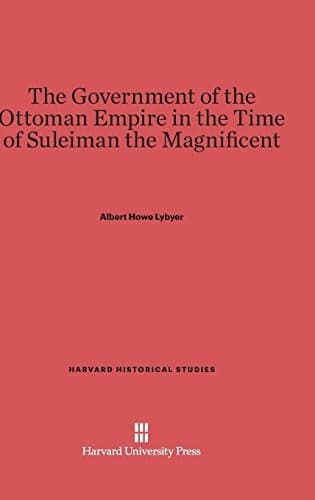
The government of the Ottoman Empire in the time of Suleiman the Magnificent — John Shaqi
The government of the Ottoman Empire in the time of Suleiman the MagnificentLybyer, Albert Howe
History
The government of the Ottoman Empire in the time of Suleiman the Magnificent
Lybyer, Albert Howe
Süleyman I, Sultan of the Turks, 1494 or 1495-1566; Turkey -- Politics and government
In order to show how clearly some of the Italian writers of the sixteenth
century understood the two institutions, though not under any particular
names, translations of certain quotations are subjoined. Since they will
serve also to justify the present writer’s point of view, no apology need
be made for their length.
Andrea Gritti, Venetian orator extraordinary to Bayezid II, in his report
to the Venetian senate on December 2, 1503, mentions the highest Turkish
officials as follows:—“For affairs of state and every other matter of
importance His Majesty is wont to take counsel with the pashas.... These
are ordinarily four in number, who reside in Constantinople; they are
born of Christian parents, seized from the provinces while small, and
educated in different places by men delegated for that purpose; raised
then to certain positions either through the affection which the Grand
Signor bears for them, or by some enterprises valorously carried through,
they quickly become very rich, selling, among matters of importance,
justice and favors; but when they find themselves at the summit of
felicity they live in great danger.”[70]
Antonio Barbarigo, Venetian _Bailo_ at Constantinople from 1555 to 1560,
speaks further of the high officials: “Nor does there exist in this so
great empire either superiority or illustriousness of blood, so that any
one can glory in his descent, but all are in an equal condition, and
they themselves wish to be named and called slaves of the Grand Signor,
and their greatest pride is when they say that they are slaves of the
Signor; and all his chief men and governors are slaves, and Christian
renegades, and sons of Christians brought up from an early age in the
seraglio, and then in time, according to their worth, exalted and
rewarded and made great by His Majesty.”[71]
Marcantonio Barbaro, _Bailo_ of Venice at Constantinople from 1568 to
1573, seems to have been the first to discern clearly the contrast of the
two institutions.
“It is a fact truly worthy of much consideration, that the riches, the
forces, the government, and in short the whole state of the Ottoman
Empire is founded upon and placed in the hands of persons all born
in the faith of Christ; who by different methods are made slaves and
transferred into the Mohammedan sect. Then whoever will carefully direct
his attention to this principal consideration, will come more easily to
an understanding of the government and nature of the Turks....
“Other sorts of persons are not ordinarily admitted to the honors
and the pay of the Grand Signor, except the above-mentioned, all
Christian-born....
Public-domain text, read in full here on John Shaqi.
Reviews
Reviews
No reviews yet
Be the first to share your thoughts on this work.
Join the Discussion
Join the discussion
Sign in to leave a comment or review.
Sign InorCreate an account