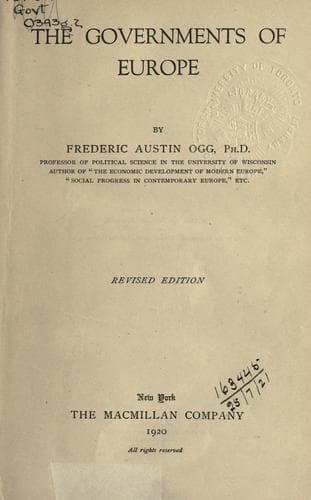
Europe -- Politics and government; Political science
*134. Payment of Members of the Commons.*--Until recently the fact that
there was no salary attached to service in Parliament operated to
debar from election to the Commons men who were not of independent
means. Through some years the Labor Party was accustomed to provide
funds wherewith its representatives were enabled to maintain
themselves at the capital,[184] but this arrangement affected only a
small group of members and was of an entirely private and casual
nature. Public and systematic payment of members, to the end that poor
but capable men might not be kept out of the Commons, was demanded by
the Chartists three-quarters of a century ago, and from time to time
after 1870 there was agitation in behalf of such a policy. In 1893,
and again in 1895, a resolution in favor of the payment of members was
adopted in the Commons, and March 7, 1906, a resolution was carried to
the effect that every member should be paid a salary of L300 annually.
But it was not until 1911 that a measure of the kind could be got
through the upper chamber. Fresh impetus was afforded by the Osborne
Judgment, in which, on an appeal from the lower courts, the House of
Lords ruled in December, 1909, that the payment of parliamentary (p. 128)
members as such from the dues collected by labor organizations was
contrary to law. The announcement of the Judgment was followed by
persistent agitation for legislation to reverse the ruling. In
connection with the budget presented to the Commons by the Chancellor
of the Exchequer May 16, 1911, the proposition was made, not to take
action one way or the other upon the Lords' decision, but to provide
for the payment to all non-official members of the House of Commons of
a yearly salary of L400; and with little delay and no great amount of
opposition the proposal was enacted into law. The amount of the salary
provided is not large, but it is ample to render candidacy for seats
possible for numbers of men who formerly could not under any
circumstances have contemplated a public career.[185]
[Footnote 184: The sum provided from the party
funds was ordinarily L200 a year.]
[Footnote 185: On the privileges of the Commons see
Anson, Law and Custom of the Constitution, I.,
153-189; Lowell, Government of England, I., Chap.
11; Walpole, Electorate and Legislature, Chap. 5;
Redlich, Procedure of the House of Commons, III.,
42-50. A standard work in which the subject is
dealt with at length is May, Treatise on the Law,
Privileges, Proceedings, and Usage of Parliament,
Chaps. 3-6.]
V. THE FUNCTIONS OF PARLIAMENT
Public-domain text, read in full here on John Shaqi.
Reviews
Reviews
No reviews yet
Be the first to share your thoughts on this work.
Elsewhere in the archive
Join the Discussion
Join the discussion
Sign in to leave a comment or review.
Sign InorCreate an account