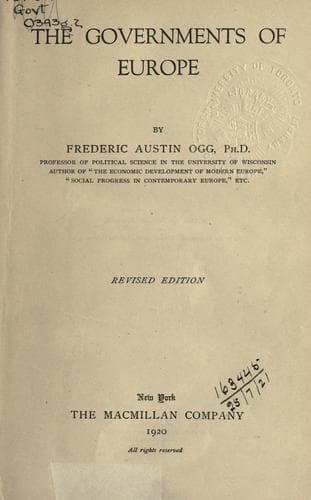
Europe -- Politics and government; Political science
When the king summons the two chambers he does so, "being desirous and
resolved as soon as may be to meet his people, and to have their
advice in Parliament." No mention is made of legislative or financial
business, and, technically, Parliament is still essentially what
originally it was exclusively, i.e., a purely deliberative
assemblage. Practically, however, the mere discussion of public
questions and the giving of advice to the crown has become but one of
several distinctive parliamentary functions. The newer functions
which, with the passing of time, have acquired ever increasing
importance are, in effect, three. The first is that of criticism,
involving the habitual scrutiny and control of the measures of the
executive and administrative organs. The second is the exercise, under
limitations to be described, of the power of judicature. The third,
and much the most important, is the function of public and private
legislation and of fiscal control.
*135. Criticism: Ministerial Responsibility.*--Parliament does not
govern and is not intended to govern. Never save when the Long
Parliament undertook the administration of public affairs through
committees of its members has Parliament asserted a disposition to
gather immediately into its own hands those powers of state which are
executive in character. At the same time, the growth of parliamentary
government has meant the establishment of a connection between the
executive and the parliamentary chambers (principally the Commons) (p. 129)
as close as may be so long as separateness of organization is still
maintained. The officials who comprise the working executive are
invariably members of Parliament. They initiate public measures,
introduce them, advocate and defend them, and, in general, guide and
control the conduct of public business both inside and outside the
chambers. But for every act they are responsible directly to the House
of Commons. They may continue in power only so long as they are
supported by a majority in that chamber. And their conduct is subject
continually to review and criticism, through the instrumentality of
questions, formal inquiries, and, if need be, judicial procedure.
Public-domain text, read in full here on John Shaqi.
Reviews
Reviews
No reviews yet
Be the first to share your thoughts on this work.
Elsewhere in the archive
Join the Discussion
Join the discussion
Sign in to leave a comment or review.
Sign InorCreate an account