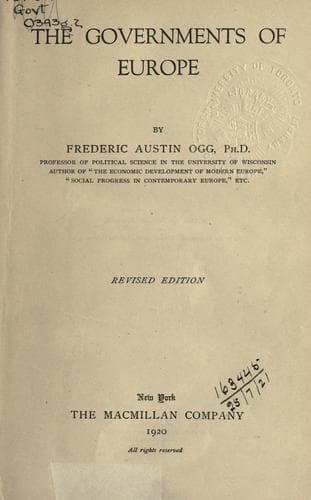
Europe -- Politics and government; Political science
*137. The House of Lords as a Court.*--Most important among surviving
parliamentary functions of a judicial character is the exercise of
appellate jurisdiction by the House of Lords. The judicial authority
of the Lords is an anomaly, although as it is actually exercised it
does not seriously contravene the principle which forbids the bringing
together of judicial and legislative powers in the same hands.
Historically, it arose from a confusion of the functions of two groups
of men which were long largely identical in personnel, i.e., the
Great Council, on the one hand, and the Lords of Parliament, on (p. 131)
the other. In the reign of Henry IV. the Commons asked specifically to
be relieved from judicial business, and the parliamentary jurisdiction
which survived was recognized thereafter to be vested in the House of
Lords alone. From an early date this jurisdiction was, as it is
to-day, both original and appellate. As a court of first instance the
chamber acquired the right to try peers charged with treason and
felony and, on the accusation of the House of Commons, to bring to
justice, through the process of impeachment, offenders who were not of
the peerage. Nowadays these powers are of no practical consequence.
The position of the Lords as an appellate tribunal, however, is still
a fundamental fact in the judicial system. Starting with control, by
way of appeal, over the courts of common law in England, the chamber
acquired in time a similar control over the English courts of
chancery, and eventually over the courts of both Scotland and Ireland.
Its jurisdiction has stopped short only of the ecclesiastical courts,
and of the courts of the outlying portions of the Empire, appeals from
which are heard in the Judicial Committee of the Privy Council. By the
Supreme Court of Judicature Act of 1873, whereby the higher tribunals
of the realm were remodelled, the appellate jurisdiction of the Lords
was abolished outright; but in 1876, before the measure had been put
in operation the plan was modified and there was passed the Appellate
Jurisdiction Act whereby the appellate functions of the Lords were
restored and provision was made for the creation at first of two,
later of three, and eventually of four, salaried life peers, to be
selected from men of eminence in the law, and to be known as Lords of
Appeal in Ordinary. In so far as it is controlled by statute at all,
the appellate jurisdiction of the chamber is regulated to-day by this
measure. Nominally, judicial business is transacted by the House as a
whole, and every member has a right not only to be present but to
participate in the rendering of decisions. Actually, such business is
transacted by a little group of law lords (the attendance of but three
being necessary) under the presidency of the Lord Chancellor, and the
unwritten rule which prohibits the presence at judicial sessions of
any persons save the law lords is quite as strictly observed as is any
Public-domain text, read in full here on John Shaqi.
Reviews
Reviews
No reviews yet
Be the first to share your thoughts on this work.
Elsewhere in the archive
Join the Discussion
Join the discussion
Sign in to leave a comment or review.
Sign InorCreate an account