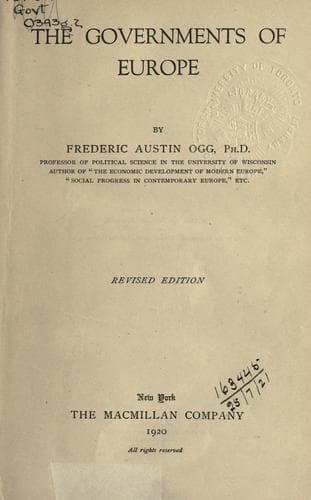
Europe -- Politics and government; Political science
A more generally effective device by which discussion is limited and
the transaction of business is facilitated is that known as "closure
by compartments," or "the guillotine." When this is employed the House
in advance of the consideration of a bill agrees upon an allotment of
time to the various parts or stages of the measure, and at the
expiration of each period debate, whether concluded or not, is closed,
a vote is taken, and a majority adopts that portion of the bill upon
which the guillotine has fallen. In recent years this device has been
employed almost invariably when an important Government bill is
reserved for consideration in Committee of the Whole. Its advantage is
the saving of time and the ensuring that by a given date final action
upon a measure shall have been taken. Prior to the middle of the
nineteenth century liberty of discussion in the Commons was all but
unrestrained, save by what an able authority on English parliamentary
practice has termed "the self-imposed parliamentary discipline of the
parties."[206] The enormous change which has come about is
attributable to two principal causes, congestion of business and the
rise of obstructionism. The effect has been, among other things, to
accentuate party differences and to involve occasional disregard of
the rights of minorities.[207]
[Footnote 206: The name was first employed in
1887.]
[Footnote 207: Redlich, Procedure of the House of
Commons, I., 133-212; Graham, The Mother of
Parliaments, 158-172. An excellent illustration of
the use of the guillotine is afforded by the
history of the passage of the National Insurance
Bill of 1911. See _Annual Register_ (1911),
232-236.]
Public-domain text, read in full here on John Shaqi.
Reviews
Reviews
No reviews yet
Be the first to share your thoughts on this work.
Elsewhere in the archive
Join the Discussion
Join the discussion
Sign in to leave a comment or review.
Sign InorCreate an account