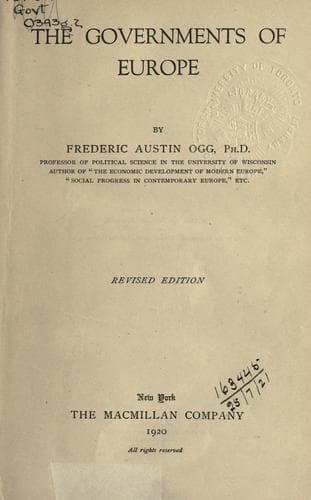
Europe -- Politics and government; Political science
*148. Votes and Divisions.*--When debate upon the whole or a portion of
a measure is terminated there takes place a vote, which may or may
not involve, technically, a "division." The Speaker or Chairman (p. 141)
states the question to be voted upon and calls for the ayes and noes.
He announces the apparent result and, if his decision is not
challenged, the vote is so recorded. If, however, any member objects,
strangers are asked to withdraw (save from the places reserved for
them), electric bells are rung throughout the building, the two-minute
sand-glass is turned, and at the expiration of the time the doors are
locked. The question is then repeated and another oral vote is taken.
If there is still lack of acquiescence in the announced result, the
Speaker orders a division. The ayes pass into the lobby at the
Speaker's right and the noes into that at his left, and all are
counted by four tellers designated by the Speaker, two from each side,
as the members return to their places in the chamber. This method of
taking a division has undergone but little change since 1836. Under a
standing order of 1888 the Speaker is empowered, in the event that he
considers a demand for a division dilatory or irresponsible, to call
upon the ayes and noes to rise in their places and be counted; but
there is seldom occasion for resort to this variation from the
established practice. The device of "pairing" is not unknown, and when
the question is one of political moment the fact is made obvious by
the activity of the party "whips" in behalf of the interests which
they represent.[208]
[Footnote 208: On the conduct of business in the
Commons see Lowell, Government of England, I,
Chaps. 15-16; Moran, English Government, Chap. 15;
Walpole, Electorate and Legislature, Chap. 8;
Ilbert, Parliament, Chap. 5; Redlich, Procedure of
the House of Commons, II., 215-264, III., 1-41;
May, Treatise on the Law, Privileges, Proceedings,
and Usage of Parliament, Chaps, 8-12; Medley,
Manual of English Constitutional History, 231-284;
Graham, The Mother of Parliaments, 225-258; and
MacDonaugh, The Book of Parliament, 217-247.]
Public-domain text, read in full here on John Shaqi.
Reviews
Reviews
No reviews yet
Be the first to share your thoughts on this work.
Elsewhere in the archive
Join the Discussion
Join the discussion
Sign in to leave a comment or review.
Sign InorCreate an account