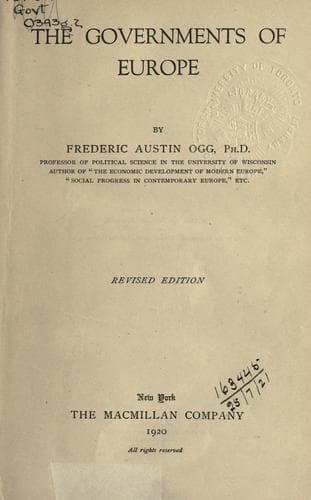
Europe -- Politics and government; Political science
*156. Party Regeneration.*--A fourth, and final, stage of the Liberal
period covered the years 1859 to 1874. Its importance arises not
merely from the fact that the culmination of the power of the Liberals
during the nineteenth century was attained at this point, but from the
further fact that it was during these years that the Liberal party was
transformed and popularized so as to be made for the first time really
worthy of the name which it bears. As long as Palmerston lived the
Liberals of the old school, men who disliked radicalism and were
content with the reform of 1832, were in the ascendancy, but after the
premier's death, October 18, 1865, new ideas and influences asserted
themselves and a new Liberal party came rapidly to the fore. This
regenerated party, whose leader was Gladstone, rejected definitely the
ideal of _laissez-faire_, took over numerous principles of the
Radicals, and, with the watchwords of "peace, retrenchment, and
reform," began to insist upon a broader parliamentary franchise and
upon fresh legislation for the protection and general betterment of
the masses. The new liberalism was paralleled, however, by a new
conservatism, whose principal exponent was Disraeli. The new
Conservatives likewise advocated franchise reform and legislation for
the people, although they put more emphasis upon the latter than upon
the former; and they especially favored a firm foreign policy, (p. 149)
an extension of British interests in all parts of the world, and the
adoption of a scheme of colonial federation. They appeared, at least,
to have less regard for peace and for economy than had the Liberals.
Public-domain text, read in full here on John Shaqi.
Reviews
Reviews
No reviews yet
Be the first to share your thoughts on this work.
Elsewhere in the archive
Join the Discussion
Join the discussion
Sign in to leave a comment or review.
Sign InorCreate an account