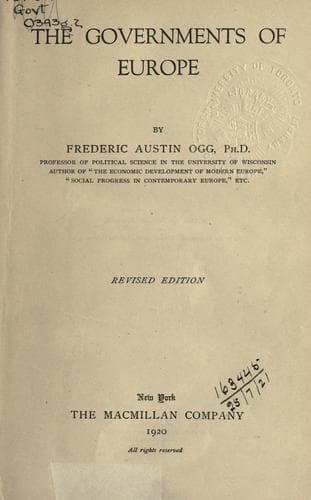
Europe -- Politics and government; Political science
The temper and tendencies of the parties as they gradually assumed
shape during the third quarter of the nineteenth century have been
characterized effectively by a recent writer as follows: "The parties
of which Gladstone and Disraeli were the chiefs were linked by
continuous historical succession with the two great sections or
factions of the aristocracy, or hereditary oligarchy, which ruled
Great Britain in the eighteenth century. But each had been transformed
by national changes since the Reform Bill. The Whigs had become
Liberals, the Tories had become Conservatives. The Liberal party had
absorbed part of the principles of the French Revolution. They stood
now for individual liberty, laying especial stress on freedom of
trade, freedom of contract, and freedom of competition. They had set
themselves to break down the rule of the landowner and the Church, to
shake off the fetters of Protection, and to establish equality before
the law. Their acceptance of egalitarian principles led them to adopt
democratic ideals, to advocate extension of the suffrage, and the
emancipation of the working classes. Such principles, though not
revolutionary, are to some extent disruptive in their tendency; and
their adoption by the Liberals had forced the Tory party to range
themselves in defense of the existing order of things. They professed
to stand for the Crown, the Church, and the Constitution. They were
compelled by the irresistible trend of events to accept democratic
principles and to carry out democratic reforms. They preferred, in
fact, to carry out such reforms themselves, in order that the
safeguards which they considered necessary might be respected.
Democratic principles having been adopted, both parties made it their
object to redress grievances; but the Conservatives showed a natural
predisposition to redress those grievances which arose from excessive
freedom of competition, the Liberals were the more anxious to redress
those which were the result of hereditary or customary privilege. The
harmony of the State consists in the equilibrium between the two
opposing forces of liberty and order. The Liberals laid more stress
upon liberty, the Conservatives attached more importance to order and
established authority."[214]
[Footnote 214: S. Leathes, in Cambridge Modern
History, XII., 30-31.]
Public-domain text, read in full here on John Shaqi.
Reviews
Reviews
No reviews yet
Be the first to share your thoughts on this work.
Elsewhere in the archive
Join the Discussion
Join the discussion
Sign in to leave a comment or review.
Sign InorCreate an account