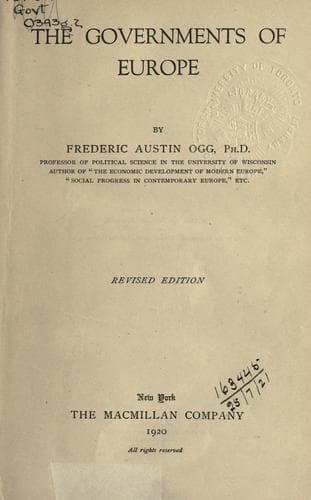
Europe -- Politics and government; Political science
*175. The Form of the Law.*--Statute law takes invariably, of course,
written form. The acts of Parliament are to be found in imposing
printed collections, to which a substantial volume is added every
year. Of the Common Law, however, there is no single or authoritative
text. The Common Law grew up originally as unwritten law, and in a
large measure it preserves still that character. The sources, however,
from which knowledge of it must be drawn are mainly in writing or in
print. The most important are (1) the decisions of the judges of the
English courts (reported anonymously in Year Books from the reign of
Edward I. to that of Henry VIII., and thereafter by lawyers reporting
under their own names) which from at least the sixteenth century
acquired weight as precedents and are nowadays all but absolutely
decisive in analogous cases; (2) the decisions of courts of other
countries in which there is administered a law derived from the English,
such decisions being, of course, not binding, yet highly influential;
and (3) certain "books of authority" written by learned lawyers (p. 169)
of earlier times, such as Coke's seventeenth-century Commentary on
Littleton's Tenures and Foster's eighteenth-century treatise on Crown
Law. Some small branches of the Common Law have, indeed, been codified
in the form of statutes, among them the law of partnership, that of
sales, and that of bills of exchange.
*176. The Rules of Equity.*--There is one other body of English law
which requires mention, namely, the rules of equity. These rules had
their origin in the administration of an extraordinary sort of justice
by the king's chancellor in mediaeval times, a practice which arose
from the sheer necessity of redressing grievances occasioned by the
omissions or commissions of the regularly constituted tribunals.
Interference on the part of the chancellor, which started as a matter
of special favor in unusual cases, became gradually an established
practice, and, contrary to the original intention, there was brought
into existence a body of definite and separate rules of equity which
by the seventeenth century acquired systematic character, and likewise
a court of chancery in which these rules were at all times
enforceable. Reports of equity cases became continuous, and lawyers of
eminence began to specialize in equity procedure. The rules of equity
thus developed partake largely of the nature of the Common Law, of
which, indeed, they are to be considered, in effect, a supplement or
appendix; and practically, though not theoretically, they prevail as
against any provisions of the ordinary Common Law with which they may
be inconsistent. Their general purpose is to afford means of
safeguarding rights which exist in morals, but which the Common Law
courts cannot or will not protect. Until 1875 they were administered
by tribunals separate from the ordinary courts. Nowadays they are not
separately administered, but they preserve, none the less, their
Public-domain text, read in full here on John Shaqi.
Reviews
Reviews
No reviews yet
Be the first to share your thoughts on this work.
Elsewhere in the archive
Join the Discussion
Join the discussion
Sign in to leave a comment or review.
Sign InorCreate an account