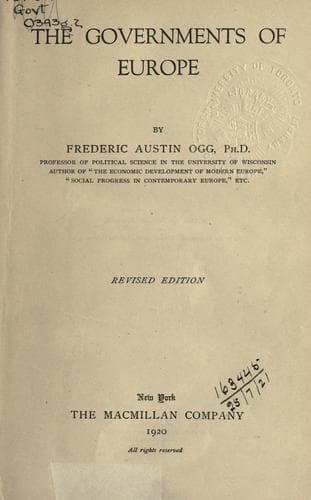
Europe -- Politics and government; Political science
highly distinctive character.[241]
[Footnote 241: Two monumental works dealing with
the earlier portions of English legal development
are F. Pollock and F. W. Maitland, History of
English Law to the Time of Edward I., 2 vols.
(Cambridge, 1898) and W. S. Holdsworth, History of
English Law, 3 vols. (London, 1903-1909). The first
volume of Holdsworth contains a history of English
courts from the Norman Conquest to the present day;
the other volumes deal exhaustively with the growth
of the law itself. Books of value include H.
Brunner, The Sources of the Law of England, trans.
by W. Hastie (Edinburgh, 1888); R. K. Wilson,
History of Modern English Law (London, 1875). J. F.
Stephen, History of the Criminal Law of England, 3
vols. (London, 1883); Ibid., Commentaries on the
Laws of England, 4 vols. (London, 1908); O. W.
Holmes, The Common Law (Boston, 1881); and H. Broom
and E. A. Hadley, Commentaries on the Laws of
England, 4 vols. (London, 1869). A recent treatise
by a German authority is J. Hatschek, Englisches
Staatsrecht mit Beruecksichtigung der fuer Schottland
und Irland geltenden Sonderheiten (Tuebingen, 1905).
An incisive work is A. V. Dicey, Law and Public
Opinion in England in the Nineteenth Century
(London, 1905). A good single volume history of the
law is E. Jenks, Short History of the English Law
(Boston, 1912). A satisfactory introduction to both
the history and the character of the law is W. M.
Geldart, Elements of English Law (London and New
York, 1912). Another is F. W. Maitland, Outlines of
English Legal History, in Collected Papers
(Cambridge, 1911), II., 417-496. Other excellent
introductory treatises are Maitland, Lectures on
Equity (Cambridge, 1909), and C. S. Kenny, Outlines
of Criminal Law (New York, 1907). Maitland's
article on English Law in the Encyclopaedia
Britannica, IX., 600-607, is valuable for its
brevity and its clearness. On the English
conception of law and the effects thereof see
Lowell, Government of England, II., Chaps. 61-62.
The character and forms of the statute law are
sketched to advantage in C. P. Ilbert, Legislative
Methods and Forms (Oxford, 1901), 1-76.]
Public-domain text, read in full here on John Shaqi.
Reviews
Reviews
No reviews yet
Be the first to share your thoughts on this work.
Elsewhere in the archive
Join the Discussion
Join the discussion
Sign in to leave a comment or review.
Sign InorCreate an account