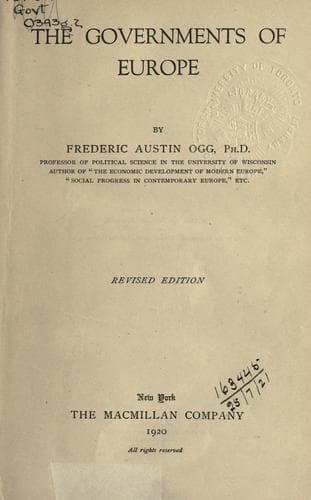
Europe -- Politics and government; Political science
*187. The Borough before 1832.*--The corporate towns in England and
Wales numbered, in 1832, 246. They comprised population centers which,
on the basis of charters granted by the crown, had become distinct
areas of local government. They did not, however, stand entirely apart
from the county and parish organization. On the contrary, except in so
far as they were exempted specifically by the terms of their charters,
they were subject to the authority of the justices of the peace and of
the governing agencies of the parishes within whose jurisdiction they
were situated. Their style of government was determined largely (p. 178)
by the provisions of their charters, and since these instruments
exhibited a marked degree of variety, uniformity of organization was
entirely lacking. As a rule, however, the borough was a close
corporation, and the burgesses, or "freemen," in whom were vested
peculiar trading and fiscal rights and an absolute monopoly of the
powers of government, comprised but a small fraction of the general
body of citizens. The governing authority of the borough was the town
council, whose members were either elected by the freemen or recruited
by co-optation. Government was regularly oligarchical and
irresponsible; sometimes it was inefficient and corrupt.
*188. The New Poor Law (1834) and the Municipal Corporations Act
(1835).*--The reforms accomplished since 1832 within the domain of
parliamentary organization and procedure have been hardly more
remarkable than those wrought during the same period within the field
of local government. It must suffice to mention but the principal
steps by which the local governing system has been brought to its
present high degree of democracy and effectiveness. Among the subjects
to which the first reformed parliament addressed its attention was the
direful condition into which had fallen the relief of the poor, and
the initial stage of local government regeneration was marked by the
adoption of the Poor Law Amendment Act of 1834, abolishing outdoor
relief for the able-bodied, providing for the regrouping of parishes
in "poor-law unions," and establishing a national Poor Law Commission.
The administration of relief within the unions was intrusted all but
exclusively to newly created boards of guardians, composed in part of
the justices of the peace sitting _ex-officio_ and in part of members
specially elected by the rate-payers. The arrangements set up by the
act proved very successful and they survive almost intact at the
present day. The second notable change was that effected by the
Municipal Corporations Act of 1835. The enfranchising of large numbers
of the townspeople in 1832 led inevitably to demand for the
democratization of the aristocratic borough governments, and within
three years the demand was met in a statute so sweeping as to justify
the assertion that with its enactment the modern history of the
English town begins.[254] Sixty-nine of the old corporate towns, by
Public-domain text, read in full here on John Shaqi.
Reviews
Reviews
No reviews yet
Be the first to share your thoughts on this work.
Elsewhere in the archive
Join the Discussion
Join the discussion
Sign in to leave a comment or review.
Sign InorCreate an account