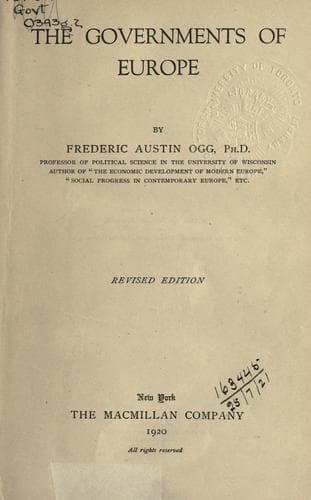
Europe -- Politics and government; Political science
reason of their unimportance, were now deprived of the character of
boroughs. The city of London was not touched, but elsewhere all
municipal corporations were broadened so as to personify legally the
entire population of the borough. The time-honored municipal oligarchy
was broken down by the giving of the franchise to all rate-payers, the
town councils were made wholly elective, trading monopolies and
privileges were swept away, and a variety of other reforms were (p. 179)
introduced. With the adoption of this important measure, however, the
work of reform came for a time to a halt, and the widely assailed
system of county government through nominated magistrates in quarter
sessions survived until 1888.[255]
[Footnote 254: Lowell, Government of England, II.,
144.]
[Footnote 255: The history of the local
institutions of England prior to 1835 is related in
detail in two comprehensive works: H. A. Merewether
and A. J. Stephens, History of the Boroughs and
Municipal Corporations of the United Kingdom, 3
vols. (London, 1835) and S. and B. Webb, English
Local Government from the Revolution to the
Municipal Corporations Act, 3 vols. (London and New
York, 1904-1908). The first of these was written to
promote the cause of municipal reform, but is
temperate and reliable. The second is especially
exhaustive, volume 3 containing probably the best
existing treatment of the history of borough
government. For a brief sketch see May and Holland,
Constitutional History of England, II., Chap. 15.]
V. LOCAL GOVERNMENT REFORM, 1835-1912
Public-domain text, read in full here on John Shaqi.
Reviews
Reviews
No reviews yet
Be the first to share your thoughts on this work.
Elsewhere in the archive
Join the Discussion
Join the discussion
Sign in to leave a comment or review.
Sign InorCreate an account