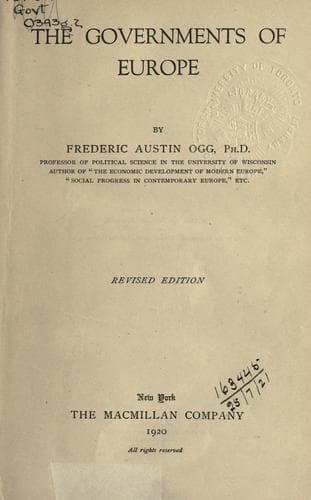
Europe -- Politics and government; Political science
von Zwiedeneck-Sudenhorst, Deutsche Geschichte
von der Aufloesung d. alten bis zur Errichtung d.
neuen Kaiserreichs (Stuttgart, 1903-1905); and M.
L. Van Deventer, Cinquante annees de l'histoire
federale de l'Allemagne (Brussels, 1870). A book of
some value is A. Malet, The Overthrow of the
Germanic Confederation by Prussia in 1866 (London,
1870). P. Bigelow, History of the German Struggle
for Liberty (New York, 1905) is readable, but not
wholly reliable. An excellent biography of Bismarck
is that by Headlam (New York, 1899). For full
bibliography see Cambridge Modern History, X.,
826-832; XI., 879-886, 893-898; XII., 869-875.]
III. THE CONSTITUTION: NATURE OF THE EMPIRE (p. 202)
*211. The Constitution Framed.*--As ordained in the treaties of
November, 1870, ratified subsequently by the _Bundesrath_ and the
_Bundestag_ of the North German Confederation, and by the legislative
assemblies of the four incoming states, the German Empire came legally
into existence January 1, 1871. It consisted fundamentally of the
Confederation, which in the process of expansion did not lose its
corporate identity, together with the four states, whose treaties
bound them severally to it. The _Bund_ was conceived of technically,
not as replaced by, but rather as perpetuated in, the new Empire. The
accession of the four southern states, however, involved of necessity
a considerable modification of the original character of the
affiliation; and the innovations that were introduced called for a
general reconstitution of the fundamental law upon which the enlarged
structure was to be grounded.
Public-domain text, read in full here on John Shaqi.
Reviews
Reviews
No reviews yet
Be the first to share your thoughts on this work.
Elsewhere in the archive
Join the Discussion
Join the discussion
Sign in to leave a comment or review.
Sign InorCreate an account