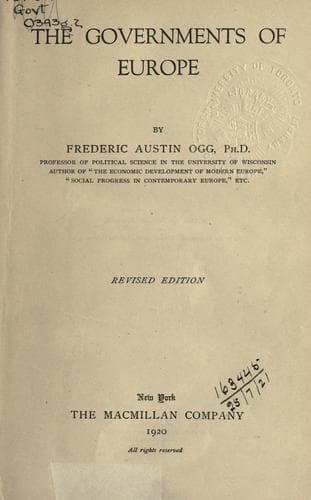
Europe -- Politics and government; Political science
The elements at hand for the construction of the constitution of the
Empire were four: (1) the constitution of the North German
Confederation, in operation since 1867; (2) the treaties of November
15, 1870, between the Confederation, on the one hand, and the
grand-duchies of Baden and Hesse on the other; (3) the treaty of
November 23, 1870, by which was arranged the adhesion of the kingdom of
Bavaria; and (4) the treaty of November 25, 1870, between the _Bund_,
Baden, and Hesse, on the one side, and the kingdom of Wuerttemberg on
the other. Each of these treaties stipulated the precise conditions
under which the new affiliation should be maintained, these
stipulations comprising, in effect, so many projected amendments of
the original constitution of the _Bund_.[282] At the initiative of the
Emperor there was prepared, early in 1871, a revised draft of this
constitution, and in it were incorporated such modifications as were
rendered necessary by the adhesion of the southern states and the
creation of the Imperial title. March 31 the Reichstag was convened in
Berlin and before it was laid forthwith the constitutional _projet_,
to which the Bundesrath had already given its assent. April 14 the
instrument was approved by the popular chamber, and two days later it
was promulgated as the supreme law of the land.
[Footnote 282: The first three of these treaties
were concluded at Versailles; the fourth was signed
at Berlin.]
Public-domain text, read in full here on John Shaqi.
Reviews
Reviews
No reviews yet
Be the first to share your thoughts on this work.
Elsewhere in the archive
Join the Discussion
Join the discussion
Sign in to leave a comment or review.
Sign InorCreate an account