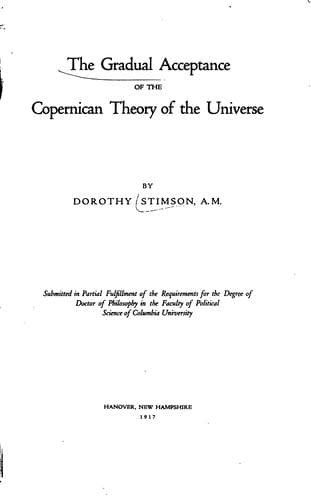
The gradual acceptance of the Copernican theory of the universeStimson, Dorothy
History
The gradual acceptance of the Copernican theory of the universe
Stimson, Dorothy
Astronomy -- History; Copernicus, Nicolaus, 1473-1543; Solar system
Produced by Suzanne Lybarger, Linda Cantoni, and the Online
Distributed Proofreading Team at http://www.pgdp.net (This
file was produced from images generously made available
by The Internet Archive/Canadian Libraries,
http://www.archive.org/details/gradualacceptan00stim)
[Transcriber's Note: Obvious printer errors have been corrected
without note. Other questionable items are marked with a
[Transcriber's Note].]
The Gradual Acceptance
OF THE
Copernican Theory of the Universe
DOROTHY STIMSON, Ph.D.
NEW YORK
1917
COPYRIGHT 1917 BY DOROTHY STIMSON
Trade Selling Agents
The Baker & Taylor Co.,
354 Fourth Ave.,
New York
TO MY FATHER AND MOTHER
[Illustration: THE SYSTEMS OF THE WORLD IN 1651 ACCORDING TO FATHER
RICCIOLI
(Reduced facsimile of the frontispiece in Riccioli: _Almagestum
Novum_. Bologna, 1651.)]
EXPLANATION
"Astrea, goddess of the heaven, wearing angel's wings and gleaming
everywhere with stars, stands at the right; on the left is Argus of
the hundred eyes, not tense, but indicating by the position of the
telescope at his knee rather than at the eyes in his head, that while
observing the work of God's hand, he appears at the same time to be
worshipping as in genuflexion." (Riccioli: _Alm. Nov._, _Præfatio_,
xvii). He points to the cherubs in the heavens who hold the planets,
each with its zodiacal sign: above him at the top is Mars, then
Mercury in its crescent form, the Sun, and Venus also in the crescent
phase; on the opposite side are Saturn in its "tripartite" form (the
ring explanation was yet to be given), the sphere of Jupiter encircled
by its four satellites, the crescent Moon, its imperfections clearly
shown, and a comet. Thus Father Riccioli summarized the astronomical
knowledge of his day. The scrolls quote Psalms 19:2, "Day unto day
uttereth speech and night unto night showeth knowledge."
Astrea holds in her right hand a balance in which Riccioli's theory of
the universe (an adaptation of the Tychonic, see p. 68) far outweighs
the Copernican or heliocentric one. At her feet is the Ptolemaic
sphere, while Ptolemy himself half lies, half sits, between her and
Argus, with the comment issuing from his mouth: "I will arise if only
I am corrected." His left hand rests upon the coat of arms of the
Prince of Monaco to whom the _Almagestum Novum_ is dedicated.
At the top is the Hebrew _Yah-Veh_, and the hand of God is stretched
forth in reference to the verse in the Book of Wisdom (10:20): "But
thou hast ordered all things in measure, and number and weight."
CONTENTS
ILLUSTRATIONS 7
PREFACE 8
PART I. AN HISTORICAL SKETCH OF THE HELIOCENTRIC
THEORY OF THE UNIVERSE.
Chapter I. The Development of Astronomical Thought to 1400:
Preliminary Review 9
Chapter II. Copernicus and his Times 20
Public-domain text, read in full here on John Shaqi.
Reviews
Reviews
No reviews yet
Be the first to share your thoughts on this work.
Join the Discussion
Join the discussion
Sign in to leave a comment or review.
Sign InorCreate an account