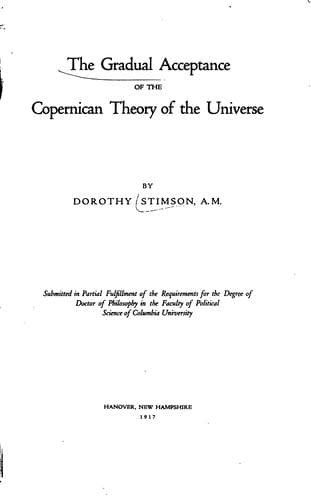
The gradual acceptance of the Copernican theory of the universeStimson, Dorothy
History
The gradual acceptance of the Copernican theory of the universe
Stimson, Dorothy
Astronomy -- History; Copernicus, Nicolaus, 1473-1543; Solar system
This I prove first: because either the air moves at an unequal rate
with the earth; or it moves equally rapidly. If not equally, then it
is certain the stone could not land at that spot, since the earth's
movement would outstrip the stone borne by the air. If equally
rapidly, then again the stone could not land at that spot, since
although the air was moving in itself at an equal speed, yet on that
account it could not carry the stone thus rapidly with itself and
carrying it downward falling by its own weight, for the stone tending
by gravity towards the center resists the carrying of the air.
You will say: if the earth is moved in a circle, so are all its parts;
wherefore that stone in falling not only moves in a circle by the
carrying of the air, but also in a circle because of its own nature as
being part of the earth and having the same motion with it.
Verily this answer is worthless. For although the stone is turned in a
circle by its own nature like the earth, yet its own natural gravity
impeded it so that it is borne along that much the less swiftly,
unlike the air or the earth, both of which are in their natural places
and which in consequence have no gravity as a stone falling from on
high has.
Lastly; because although the stone is moved in the world by its own
nature like the whole earth, yet it is not borne along as swiftly as
the whole earth. For as one stone by its own weight falls from the
heaven following its own direct motion straight to the center just as
a part of the earth, so also the whole earth itself would fall; and
yet it would not fall so swiftly as the whole earth, for although the
stone would be borne along in its sphere like the whole earth just as
a part of it, yet it would not be borne along as swiftly as the whole
earth; and so, in whatever way it is said, the motion of the earth
ought always to outstrip the stone and leave it a long distance
behind. Thus a stone could never fall at the point selected or a point
perpendicularly beneath it. This is false. Ergo.
Ninthly: If the earth is moved in a circular orbit, it ought to pass
from the west through the meridian to the east; consequently the air
ought to move by the same path. But if this were so, then if an archer
shot toward the east, his arrow ought to fly much farther than if he
shot toward the west. For when he shot toward the east, the arrow
would fly with the natural movement of the air and would have that
supporting it. But when he shot toward the west, he would have the
motion of the air against him and then the arrow would struggle
against it. But it is certain the arrow ought to go much farther and
faster when the movement of the air is favorable to it then when
against it, as is obvious in darts sent out with a favoring wind.
Ergo.
Public-domain text, read in full here on John Shaqi.
Reviews
Reviews
No reviews yet
Be the first to share your thoughts on this work.
Elsewhere in the archive
Join the Discussion
Join the discussion
Sign in to leave a comment or review.
Sign InorCreate an account