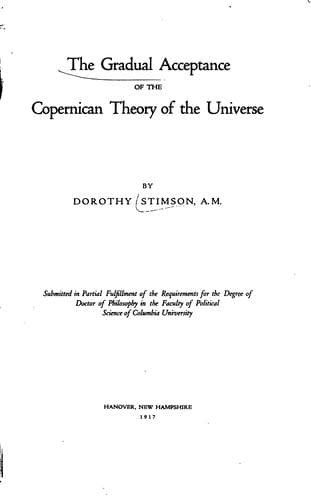
The gradual acceptance of the Copernican theory of the universeStimson, Dorothy
History
The gradual acceptance of the Copernican theory of the universe
Stimson, Dorothy
Astronomy -- History; Copernicus, Nicolaus, 1473-1543; Solar system
Nor is it moved by any other that may move the earth; as that which
moves the earth could not at the same time and with like motion move
the air. For since the air is different from the earth in essence, in
both active and passive qualities, and in kind of substance, it can
not receive the impelling force of the acting body, or that force
applied in the same way as the earth, and so could not be moved in the
same way. The virtues [of bodies] acting and of moving diversely are
received by the recipients according to the diversity of their
dispositions. Also it can not be moved by the earth; since if it were
moved by the earth, it must be said to be moved by force, but such
motion appears to be impossible. Ergo. The minor premise is proved:
for if air is thus moved by the earth by force the air ought to be
moved more rapidly than the earth, because air is larger [than the
earth].
For what is outside is larger than what is inside. When, however, what
is larger and what is outside is driven around equally rapidly with
what is less, and what is inside, then the former is moved much more
rapidly. Thus it is true that the sphere of Saturn in its daily course
is moved far faster than the sphere of the moon. But it is impossible
that the one driven should move more rapidly than the one driving;
therefore the air is not moved by the earth's violence. Thus would it
be if the air were moved with the earth, or by itself, or by force.
Thus far, then, the force of the original argument remains; since of
its own motion, indeed, it could not be in every way conformable to
the motion of the earth as I have shown; and this because the air
differs from the earth in consistency of substance, in qualities and
in essence. But the air ought at all events to move more sluggishly
than the earth. It follows from this that an arrow shot straight up
could not return to its starting point; for the earth, moving like the
air, on account of the other's slower rate leaves it behind, and the
arrow also which is carried away from it.
Besides, if the air does not move so rapidly as the earth, a man
living in a very high tower, however quiet the air, ought then always
to feel the strongest wind and the greatest disturbance of the air.
Since mountains and towers are moved with the earth, and the air would
not be accompanying them at an equal speed, it would necessarily
follow that they would precede the air by cleaving and cutting and
ploughing through it which ought to make a great wind perceptible.
Eighthly; if a person stood in some very high tower or other high
place and aimed from that tower at some spot of earth perpendicularly
below his eye, and allowed a very heavy stone to fall following that
perpendicular line, it is absolutely certain that that stone would
land upon the spot aimed at perpendicularly underneath. But if the
earth is moved, it would be impossible for the stone to strike that
spot.
Public-domain text, read in full here on John Shaqi.
Reviews
Reviews
No reviews yet
Be the first to share your thoughts on this work.
Elsewhere in the archive
Join the Discussion
Join the discussion
Sign in to leave a comment or review.
Sign InorCreate an account