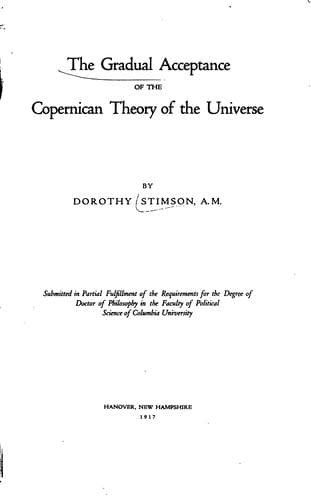
The gradual acceptance of the Copernican theory of the universeStimson, Dorothy
History
The gradual acceptance of the Copernican theory of the universe
Stimson, Dorothy
Astronomy -- History; Copernicus, Nicolaus, 1473-1543; Solar system
Such a study has been rendered possible only by the generous loan of
rare books by Professor Herbert D. Foster of Dartmouth College,
Professor Edwin E. Slosson of Columbia University, Doctor George A.
Plimpton and Major George Haven Putnam, both of New York, and
especially by the kindly generosity of Professor David Eugene Smith of
Teachers College who placed his unique collection of rare mathematical
books at the writer's disposal and gave her many valuable suggestions
as to available material. Professors James T. Shotwell and Harold
Jacoby of Columbia University have read parts of this study in
manuscript. The writer gratefully acknowledges her indebtedness not
only to these gentlemen, but to the many others, librarians and their
assistants, fellow-students and friends, too numerous to mention
individually, whose ready interest and whose suggestions have been of
real service, and above all to Professor James Harvey Robinson at
whose suggestion and under whose guidance the work was undertaken, and
to the Reverend Doctor Henry A. Stimson whose advice and criticism
have been an unfailing source of help and encouragement.
PART ONE
AN HISTORICAL SKETCH OF THE HELIOCENTRIC THEORY OF THE UNIVERSE.
CHAPTER I.
THE DEVELOPMENT OF ASTRONOMICAL THOUGHT TO 1400 A.D.
_A Preliminary Sketch of Early Theories as a Background._
The appearances in the heavens have from earliest historic ages filled
men with wonder and awe; then they gradually became a source of
questioning, and thinkers sought for explanations of the daily and
nightly phenomena of sun, moon and stars. Scientific astronomy,
however, was an impossibility until an exact system of chronology was
devised.[1] Meanwhile men puzzled over the shape of the earth, its
position in the universe, what the stars were and why the positions of
some shifted, and what those fiery comets were that now and again
appeared and struck terror to their hearts.
[Footnote 1: The earliest observation Ptolemy uses is an Egyptian one
of an eclipse occurring March 21, 721 B.C. (Cumont: 7). [In these
references, the Roman numerals refer to the volume, the Arabic to the
page, except as stated otherwise. The full title is given in the
bibliography at the back under the author's name.]]
Public-domain text, read in full here on John Shaqi.
Reviews
Reviews
No reviews yet
Be the first to share your thoughts on this work.
Join the Discussion
Join the discussion
Sign in to leave a comment or review.
Sign InorCreate an account