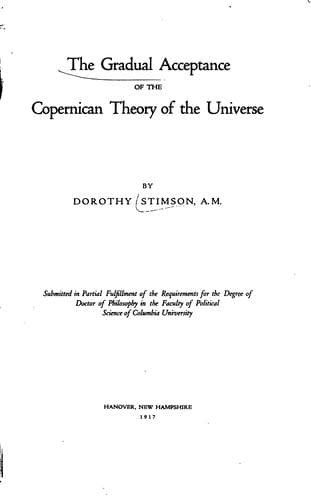
The gradual acceptance of the Copernican theory of the universe — John Shaqi
The gradual acceptance of the Copernican theory of the universeStimson, Dorothy
History
The gradual acceptance of the Copernican theory of the universe
Stimson, Dorothy
Astronomy -- History; Copernicus, Nicolaus, 1473-1543; Solar system
Rumors of trouble reached Galileo and, urged on by his friends, in
1615 he wrote a long formal elaboration of the earlier letter,
addressing this one to the Dowager Grand Duchess, but he had only
added fuel to the fire. At the end of the year he voluntarily went to
Rome, regardless of any possible danger to himself, to see if he could
not prevent a condemnation of the doctrine.[246] It came as a decided
surprise to him to receive an order to appear before Cardinal
Bellarmin on February 26, 1616,[2] and there to learn that the Holy
Office had already condemned it two days before. He was told that the
Holy Office had declared: first, "that the proposition that the sun is
the center of the universe and is immobile is foolish and absurd in
philosophy and formally heretical since it contradicts the express
words of the Scriptures in many places, according to the meaning of
the words and the common interpretation and sense of the Fathers and
the doctors of theology; and, secondly, that the proposition that the
earth is not the center of the universe nor immobile receives the same
censure in philosophy and in regard to its theological truth, it at
least is erroneous in Faith."[247]
[Footnote 246: Doc. in Favaro: 78.]
[Footnote 247: Ibid: 61.]
Exactly what was said at that meeting between the two men became the
crucial point in Galileo's trial sixteen years later, hence a somewhat
detailed study is important. At the meeting of the Congregation on
February 25th, the Pope ordered Cardinal Bellarmin to summon Galileo
and, in the presence of a notary and witnesses lest he should prove
recusant, warn him to abandon the condemned opinion and in every way
to abstain from teaching, defending or discussing it; if he did not
acquiesce, he was to be imprisoned.[248] The Secret Archives of the
Vatican contain a minute reporting this interview (dated February 26,
1616), in which the Cardinal is said to have ordered Galileo to
relinquish this condemned proposition, "nec eam de cætero, quovis
modo, teneat, doceat aut defendat, verbo aut scriptis," and that
Galileo promised to obey.[249] Rumors evidently were rife in Rome at
the time as to what had happened at this secret interview, for Galileo
wrote to the Cardinal in May asking for a statement of what actually
had occurred so that he might silence his enemies. The Cardinal
replied:
Public-domain text, read in full here on John Shaqi.
Reviews
Reviews
No reviews yet
Be the first to share your thoughts on this work.
Join the Discussion
Join the discussion
Sign in to leave a comment or review.
Sign InorCreate an account