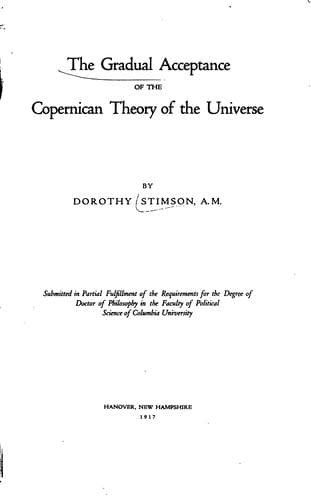
The gradual acceptance of the Copernican theory of the universeStimson, Dorothy
History
The gradual acceptance of the Copernican theory of the universe
Stimson, Dorothy
Astronomy -- History; Copernicus, Nicolaus, 1473-1543; Solar system
In 1630 he brought the completed manuscript to Riccardi, Master of the
Sacred Palace, for permission to print it in Rome. After much reading
and re-reading of it both by Riccardi and his associate, Father
Visconti, permission was at length granted on condition that he insert
a preface and a conclusion practically dictated by Riccardi,
emphasizing its hypothetical character.[260] The Pope's own argument
was to be used: "God is all-powerful; all things are therefore
possible to Him; ergo, the tides cannot be adduced as a necessary
proof of the double motion of the earth without limiting God's
omnipotence--which is absurd."[261] Galileo returned to Florence in
June with the permission to print his book in Rome. Meanwhile the
plague broke out. He decided to print it in Florence instead, and on
writing to Riccardi for that permission, the latter asked for the book
to review it again. The times were too troublesome to risk sending it,
so a compromise was finally effected: Galileo was to send the preface
and conclusion to Rome and Riccardi agreed to instruct the Inquisitor
at Florence as to his requirements and to authorize him to license the
book.[262] The parts were not returned from Rome till July, 1631, and
the book did not appear till February of the following year, when it
was published at Florence with all these licenses, both the Roman and
the Florentine ones.
[Footnote 260: Doc. in Favaro: 70.]
[Footnote 261: Fahie: 230.]
[Footnote 262: Ibid: 240.]
The _Dialogo_ was in Italian so that all could read it. It begins with
an outline of the Aristotelian system, then points out the
resemblances between the earth and the planets. The second "day"
demonstrates the daily rotation of the earth on its axis. The next
claims that the necessary stellar parallax is too minute to be
observed and discusses the earth's annual rotation. The last seeks to
prove this rotation by the ebb and flow of the tides. It is a
brilliant book and received a great reception.
The authorities of the Inquisition at once examined it and denounced
Galileo (April 17, 1633) because in it he not merely taught and
defended the "condemned doctrine but was gravely suspected of firm
adherence to this opinion."[263] Other charges made against him were
that he had printed the Roman licenses without the permission of the
Congregation, that he had printed the preface in different type so
alienating it from the body of the book, and had put the required
conclusion into the mouth of a fool (Simplicio), that in many places
he had abandoned the hypothetical treatment and asserted the forbidden
doctrine, and that he had dealt indecisively with the matter though
the Congregation had specifically condemned the Copernican doctrine as
contrary to the express words of the Scripture.[264]
[Footnote 263: Doc. in Favaro: 88-89. [Transcriber's Note: Missing
footnote reference in original text has been added above in a logical
place.]]
[Footnote 264: Ibid: 66.]
Public-domain text, read in full here on John Shaqi.
Reviews
Reviews
No reviews yet
Be the first to share your thoughts on this work.
Join the Discussion
Join the discussion
Sign in to leave a comment or review.
Sign InorCreate an account