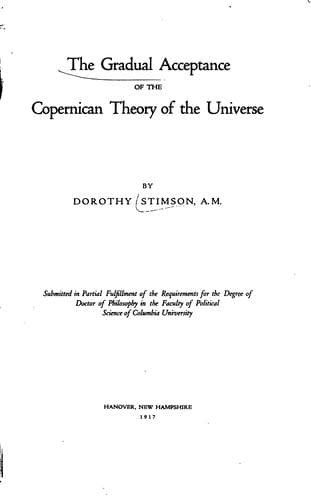
The gradual acceptance of the Copernican theory of the universeStimson, Dorothy
History
The gradual acceptance of the Copernican theory of the universe
Stimson, Dorothy
Astronomy -- History; Copernicus, Nicolaus, 1473-1543; Solar system
The high-water mark of opposition after Galileo's condemnation was
reached in the _Almagestum Novum_ (Bologna, 1651) by Father Riccioli
of the Society of Jesus. It was the authoritative answer of that
order, the leaders of the Church in matters of education, to the
challenges of the literary world for a justification of the
condemnation of the Copernican doctrine and of Galileo for upholding
it. Father Riccioli had been professor of philosophy and of
mathematics for six years and of theology for ten when by order of his
superiors, he was released from his lectureship to prepare a book
containing all the material he could gather together on this great
controversy of the age.[328] He wrote it as he himself said, as "an
_apologia_ for the Sacred Congregation of the Cardinals who officially
pronounced these condemnations, not so much because I thought such
great height and eminence needed this at my hands but especially in
behalf of Catholics; also out of the love of truth to which every
non-Catholic, even, should be persuaded and from a certain notable
zeal and eagerness for the preservation of the Sacred Scriptures
intact and unimpaired; and lastly because of that reverence and
devotion which I owe from my particular position toward the Holy,
Catholic and Apostolic Church."[329]
[Footnote 328: Riccioli: _Alm. Nov._: Præfatio, I, xviii.]
[Footnote 329: Riccioli: _Alm. Nov._: II, 496.]
This monumental work, the most important literary production of the
Society in the 17th century,[330] is abundant witness to Riccioli's
remarkable erudition and industry. Nearly one-fifth of the total bulk
of the two huge volumes is devoted to a statement of the Copernican
controversy. This is prefaced by a brief account of his own theory of
the universe--the invention of which is another proof of the ability
of the man--for his scientific training prevented his acceptance of
the Aristotelian-Ptolemaic theory in the light of Galileo's
discoveries; his position as a Jesuit and a faithful son of the Church
precluded him from adopting the system condemned by its
representatives; and Tycho Brahe's scheme was not wholly to his
liking. Therefor he proposed an adaptation of the last-named, more in
accordance, as he thought, with the facts.[331] Where Tycho had all
the planets except the earth and the moon encircle the sun, and that
in turn, together with the moon and the sphere of the fixed stars,
sweep around the earth as the center of the universe, Riccioli made
only Mars, Mercury and Venus encircle the sun,--Mars with an orbit the
radius of which included the earth within its sweep, the other two
planets with orbital radii shorter than that of the sun, and so
excluding the earth. This he did, (1) because both Jupiter and Saturn
have their own kingdoms in the heavens, and Mars, Mercury and Venus
are but satellites of the sun; (2) because there are greater varieties
of eccentricity among these three than the other two; (3) because
Public-domain text, read in full here on John Shaqi.
Reviews
Reviews
No reviews yet
Be the first to share your thoughts on this work.
Elsewhere in the archive
Join the Discussion
Join the discussion
Sign in to leave a comment or review.
Sign InorCreate an account