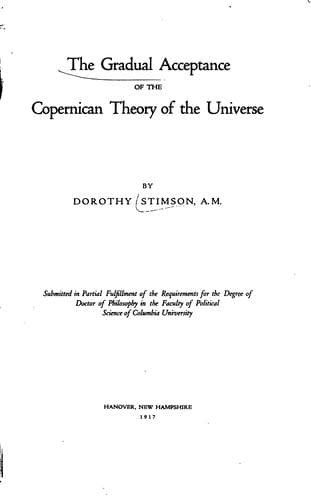
The gradual acceptance of the Copernican theory of the universeStimson, Dorothy
History
The gradual acceptance of the Copernican theory of the universe
Stimson, Dorothy
Astronomy -- History; Copernicus, Nicolaus, 1473-1543; Solar system
Protestant England was of course little disturbed by the decree
against the Copernican doctrine, a fact that makes it possible,
perhaps, to see there more clearly the change in people's attitude
from antagonism to acceptance, than in Catholic Europe where fear of
the Church's power, and respect for its decisions inhibited honest
public expression of thought and conviction. While in England also the
literal interpretation of the Scriptures continued to be with the
common people a strong objection against the doctrine, the rationalist
movement of the late seventeenth and eighteenth centuries along with
Newton's great work, helped win acceptance for it among the better
educated classes.
Bruno had failed to win over his English hearers, and in 1600 when the
_De Magnete_ was published, William Gilbert, (1540-1603) was
apparently the only supporter of the earth's movement then in
England,[357] and he advocated the diurnal motion only.[358] Not many,
however, were as outspoken as Bacon in denunciation of the system;
they were simply somewhat ironically indifferent. An exception to this
was Dean Wren of Windsor (father of the famous architect). He could
not speak strongly enough against it in his marginal notes on Browne's
_Pseudodoxia Epidemica_. As Dr. Johnson wrote,[359] Sir Thomas Browne
(1605-1682) himself in his zeal for the old errors, did not easily
admit new positions, for he never mentioned the motion of the earth
but with contempt and ridicule. This was not enough for the Dean, who
wrote in the margin of Browne's book, at such a passage,[360] that
there were "eighty-odd expresse places in the Bible affirming in
plaine and overt terms the naturall and perpetuall motion of sun and
moon" and that "a man should be affrighted to follow that audacious
and pernicious suggestion which Satan used, and thereby undid us all
in our first parents, that God hath a double meaning in his commands,
in effect condemning God of amphibologye. And all this boldness and
overweaning having no other ground but a seeming argument of some
phenomena forsooth, which notwithstanding we know the learned Tycho,
prince of astronomers, who lived fifty-two years since Copernicus,
hath by admirable and matchlesse instruments and many yeares exact
observations proved to bee noe better than a dreame."
Public-domain text, read in full here on John Shaqi.
Reviews
Reviews
No reviews yet
Be the first to share your thoughts on this work.
Elsewhere in the archive
Join the Discussion
Join the discussion
Sign in to leave a comment or review.
Sign InorCreate an account