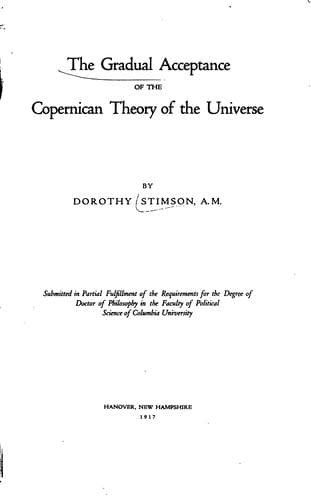
The gradual acceptance of the Copernican theory of the universeStimson, Dorothy
History
The gradual acceptance of the Copernican theory of the universe
Stimson, Dorothy
Astronomy -- History; Copernicus, Nicolaus, 1473-1543; Solar system
[Footnote 357: Berry quotes (p. 92) a passage from Thomas Digges (d.
1595) with the date 1590: "But in this our age, one rare witte (seeing
the continuall errors that from time to time more and more continually
have been discovered, besides the infinite absurdities in their
Theoricks, which they have been forced to admit that would not confess
any mobility in the ball of the Earth) hath by long studye, paynfull
practise, and rare invention delivered a new Theorick or Model of the
World, shewing that the Earth resteth not in the Center of the whole
world or globe of elements, which encircled or enclosed in the Moone's
orbit, and together with the whole globe of mortality is carried round
about the Sunne, which like a king in the middst of all, rayneth and
giveth laws of motion to all the rest, sphærically dispersing his
glorious beames of light through all this sacred celestiall Temple."
Browne also refers to Digges (I, 383).]
[Footnote 358: Gilbert: _De Magnete_, Bk. VI, c. 3-5 (214-228).]
[Footnote 359: Johnson: _Life_, in Browne: I, xvii.]
[Footnote 360: Browne: I, 35.]
Richard [Transcriber's Note: Robert] Burton (1576-1639) in
_The Anatomy of Melancholy_ speaks of the doctrine as a "prodigious
tenent, or paradox," lately revived by "Copernicus, Brunus and some
others," and calls Copernicus in consequence the successor of
Atlas.[361] The vast extent of the heavens that this supposition
requires, he considers "quite opposite to reason, to natural
philosophy, and all out as absurd as disproportional, (so some will)
as prodigious, as that of the sun's swift motion of the heavens." If
the earth is a planet, then other planets may be inhabited (as
Christian Huygens argued later on); and this involves a possible
plurality of worlds. Burton laughs at those who, to avoid the Church
attitude and yet explain the celestial phenomena, invent new
hypotheses and new systems of the world, "correcting others, doing
worse themselves, reforming some and marring all," as he says of
Roeslin's endeavors. "In the meantime the world is tossed in a blanket
amongst them; they hoyse the earth up and down like a ball, make it
stand and goe at their pleasure."[362] He himself was indifferent.
[Footnote 361: Burton: _Anatomy of Melancholy_, I, 1; I, 66. First
edition, 1621; reprinted 1624, 1628, 1632, 1638, 1651-2, 1660, 1676.]
[Footnote 362: Ibid: I, 385, 389.]
Others more sensitive to the implications of this system, might
exclaim with George Herbert (1593-1633):[363]
"Although there were some fourtie heav'ns, or more,
Sometimes I peere above them all;
Sometimes I hardly reach a score,
Sometimes to hell I fall.
"O rack me not to such a vast extent,
Those distances belong to thee.
The world's too little for thy tent,
A grave too big for me."
[Footnote 363: Herbert: II, 315.]
Or they might waver, undecided, like Milton who had the archangel
answer Adam's questions thus:[364]
Public-domain text, read in full here on John Shaqi.
Reviews
Reviews
No reviews yet
Be the first to share your thoughts on this work.
Elsewhere in the archive
Join the Discussion
Join the discussion
Sign in to leave a comment or review.
Sign InorCreate an account