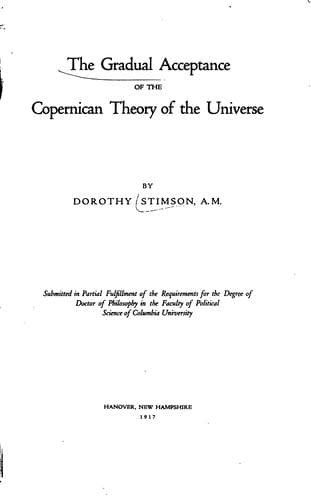
The gradual acceptance of the Copernican theory of the universeStimson, Dorothy
History
The gradual acceptance of the Copernican theory of the universe
Stimson, Dorothy
Astronomy -- History; Copernicus, Nicolaus, 1473-1543; Solar system
"But whether thus these things, or whether not,
Whether the Sun predominant in Heaven
Rise on the Earth, or Earth rise on the Sun,
Hee from the East his flaming robe begin,
Or Shee from West her silent course advance
With inoffensive pace that spinning sleeps
On her soft axle, while she paces ev'n
And bears thee soft with the smooth Air along,
Solicit not thy thoughts with matters hid,
Leave them to God above, him serve and feare;
Of other Creatures, as him pleases best,
Wherever plac't, let him dispose; joy thou
In what he gives to thee, this Paradise
And the fair Eve: Heaven is for thee too high
To know what passes there: be lowlie wise." (1667)
[Footnote 364: Milton: _Paradise Lost_, Bk. VIII, lines 159 _et seq._
The great Puritan divine, John Owen (1616-1683), accepts the miracle
of the sun's standing still without a word of reference to the new
astronomy. (_Works_: II, 160.) Farrar states that Owen declared
Newton's discoveries were against the evident testimonies of Scripture
(Farrar: _History of Interpretation_: xviii.), but I have been unable
to verify this statement. Owen died before the _Principia_ was
published in 1687.]
Whewell thinks[365] that at this time the diffusion of the Copernican
system was due more to the writings of Bishop Wilkins than to those of
any one else, for their very extravagances drew stronger attention to
it. The first, "The Discovery of a New World: or a Discourse tending
to prove that there may be another habitable world in the moon,"
appeared in 1638; and a third edition was issued only two years later
together with the second book; "Discourse concerning a New
Planet--that 'tis probable our Earth is one of the planets." In this
latter, the Bishop stated certain propositions as indubitable; among
these were, that the scriptural passages intimating diurnal motion of
the sun or of the heavens are fairly capable of another
interpretation; that there is no sufficient reason to prove the earth
incapable of those motions which Copernicus ascribes to it; that it is
more probable the earth does move than the heavens, and that this
hypothesis is exactly agreeable to common appearances.[366] And these
books appeared when political and constitutional matters, and not
astronomical ones, were the burning questions of the day in England.
[Footnote 365: Whewell: I, 410.]
[Footnote 366: Wilkins: _Discourse Concerning a New Planet_.]
The spread of the doctrine was also helped by Thomas Salusbury's
translations of the books and passages condemned by the Index in 1616
and 1619. This collection, "intended for gentlemen," he published by
popular subscription immediately after the Restoration,[367] a fact
that indicates that not merely mathematicians (whom Whewell
claims[368] were by that time all decided Copernicans) but the general
public were interested and awake.[369]
[Footnote 367: Salusbury: _Math. Coll._: To the Reader.]
[Footnote 368: Whewell: I, 411.]
Public-domain text, read in full here on John Shaqi.
Reviews
Reviews
No reviews yet
Be the first to share your thoughts on this work.
Elsewhere in the archive
Join the Discussion
Join the discussion
Sign in to leave a comment or review.
Sign InorCreate an account