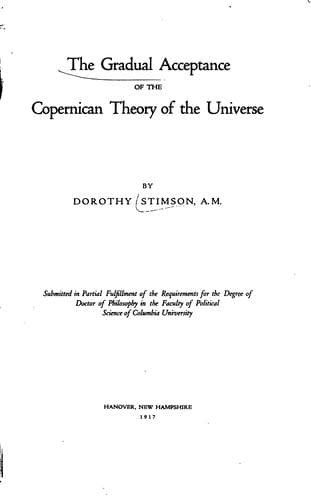
The gradual acceptance of the Copernican theory of the universeStimson, Dorothy
History
The gradual acceptance of the Copernican theory of the universe
Stimson, Dorothy
Astronomy -- History; Copernicus, Nicolaus, 1473-1543; Solar system
"But among this set of writers, there are none who more
gratify and enlarge the imagination, than the authors of the
new philosophy, whether we consider their theories of the
earth or heavens, the discoveries they have made by glasses,
or any other of their contemplations on nature.... But when
we survey the whole earth at once, and the several planets
that lie within its neighborhood, we are filled with a
pleasing astonishment, to see so many worlds hanging one
above another, and sliding around their axles in such an
amazing pomp and solemnity. If, after this, we contemplate
those wide fields of æther, that reach in height as far as
from Saturn to the fixed stars, and run abroad almost to an
infinitude, our imagination finds its capacity filled with
so immense a prospect, as puts it upon the stretch to
comprehend it. But if we yet rise higher, and consider the
fixed stars as so many vast oceans of flame, that are each
of them attended with a different set of planets, and still
discover new firmaments and new lights, that are sunk
farther in those unfathomable depths of æther, so as not to
be seen by the strongest of our telescopes, we are lost in
such a labyrinth of suns and worlds, and confounded with the
immensity and magnificence of nature.
"Nothing is more pleasant to the fancy, than to enlarge
itself by degrees, in its contemplation of the various
proportions which its several objects bear to each other,
when it compares the body of man to the bulk of the whole
earth, the earth to the circle it describes round the sun,
that circle to the sphere of the fixed stars, the sphere of
the fixed stars to the circuit of the whole creation, the
whole creation itself to the infinite space that is
everywhere diffused around it; ... But if, after all this,
we take the least particle of these animal spirits, and
consider its capacity wrought into a world, that shall
contain within those narrow dimensions a heaven and earth,
stars and planets, and every different species of living
creatures, in the same analogy and proportion they bear to
each other in our own universe; such a speculation, by
reason of its nicety, appears ridiculous to those who have
not turned their thoughts that way, though, at the same
time, it is founded on no less than the evidence of a
demonstration."[375]
[Footnote 374: Pope: _Works_, VI, 110.]
[Footnote 375: Addison: _Spectator_, No. 420, (IV, 372-373). An
interesting contrast to this passage and a good illustration of how
the traditional phraseology continued in poetry is found in Addison's
famous hymn, written a year later:
"Whilst all the stars that round her [earth] burn
And all the planets in their turn,
Confirm the tidings as they roll,
And spread the truth from pole to pole.
Public-domain text, read in full here on John Shaqi.
Reviews
Reviews
No reviews yet
Be the first to share your thoughts on this work.
Elsewhere in the archive
Join the Discussion
Join the discussion
Sign in to leave a comment or review.
Sign InorCreate an account