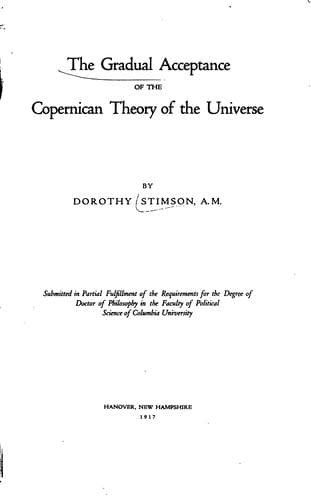
The gradual acceptance of the Copernican theory of the universeStimson, Dorothy
History
The gradual acceptance of the Copernican theory of the universe
Stimson, Dorothy
Astronomy -- History; Copernicus, Nicolaus, 1473-1543; Solar system
"What though in solemn silence all
Move round this dark terrestrial ball;
What though no real voice nor sound
Amidst their radiant orbs be found;
"In reason's ear they all rejoice,
And utter forth a glorious voice;
Forever singing, as they shine,
'The hand that made us is divine'."]
A little later, Cotton Mather declared (1721) that the "Copernican
hypothesis is now generally preferred," and "that there is no
objection against the motion of the earth but what has had a full
solution."[376] Soon the semi-popular scientific books took up the
Newtonian astronomy. One such was described as "useful for all
sea-faring Men, as well as Gentlemen, and Others."[377]
"Newtonianisme pour les Dames" was advertised in France in the
forties.[378] By 1738 when Pope wrote the _Universal Prayer_:
"Yet not to earth's contracted span
Thy goodness let me bound
Or think thee Lord alone of man,
When thousand worlds are round,"
the Copernican-Newtonian astronomy had become a commonplace to most
well-educated people in England. To be sure, the great John Wesley
(1770) considered the systems of the universe merely "ingenious
conjectures," but then, he doubted whether "more than Probabilities we
shall ever attain in regard to things at so great a distance from
us."[379]
[Footnote 376: Mather: _Christian Philosopher_, 75, 76.]
[Footnote 377: Leadbetter: _Astronomy_ (1729).]
[Footnote 378: In de Maupertius: _Ouvrages Divers_, (at the back).]
[Footnote 379: Wesley: _Compendium of Natural Philosophy_, I, 14,
139.]
The old phraseology, however, did recur occasionally, especially in
poetry and in hymns. For instance, a hymnal (preface dated 1806)
contains such choice selections as:
"Before the pondr'ous earthly globe
In fluid air was stay'd,
Before the ocean's mighty springs
Their liquid stores display'd"--
and:
"Who led his blest unerring hand
Or lent his needful aid
When on its strong unshaken base
The pondr'ous earth was laid?"[380]
[Footnote 380: Dobell: _Hymns_, No. 5, No. 10.]
But too much importance should not be attributed to such passages;
though poetry and astronomy need not conflict, as Keble
illustrated:[381]
"Ye Stars that round the Sun of Righteousness
In glorious order roll...."
[Footnote 381: Keble: _Christian Year_, 279.]
By the middle of the 18th century in England, one could say with Horne
"that the Newtonian System had been in possession of the chair for
some years;"[382] but it had not yet convinced the common people, for
as Pike wrote in 1753, "Many Common Christians to this day firmly
believe that the earth really stands still and that the sun moves all
round the earth once a day: neither can they be easily persuaded out
of this opinion, because they look upon themselves bound to believe
what the Scripture asserts."[383]
[Footnote 382: Horne: _Fair, Candid, Impartial Statement ..._, 4.]
[Footnote 383: Pike: _Philosophia Sacra_, 43.]
Public-domain text, read in full here on John Shaqi.
Reviews
Reviews
No reviews yet
Be the first to share your thoughts on this work.
Elsewhere in the archive
Join the Discussion
Join the discussion
Sign in to leave a comment or review.
Sign InorCreate an account