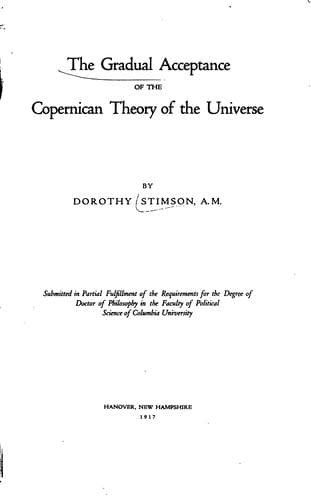
The gradual acceptance of the Copernican theory of the universeStimson, Dorothy
History
The gradual acceptance of the Copernican theory of the universe
Stimson, Dorothy
Astronomy -- History; Copernicus, Nicolaus, 1473-1543; Solar system
There was, however, just at this time a little group of thinkers who
objected to Newton's scheme, "because of the endless uninterrupted
flux of matter from the sun in light, an expense which should destroy
that orb."[384] These Hutchinsonians conceived of light as pure ether
in motion springing forth from the sun, growing more dense the further
it goes till it becomes air, and, striking the circumference of the
universe (which is perhaps an immovable solid), is thrown back toward
the sun and melted into light again. Its force as its tides of motion
strike the earth and the other planets produces their constant
gyrations.[385] Men like Duncan Forbes, Lord President of the Court of
Sessions, and George Horne, President of Magdalen College, Oxford, as
a weapon against rationalism, favored this notion that had been
expounded by John Hutchinson (1674-1737) in his _Moses's Principia_
(1724).[386] They were also strongly attracted by the scriptural
symbolism with which the book abounds. Leslie Stephen summarizes their
doctrines as (1) extreme dislike for rationalism, (2) a fanatical
respect for the letter of the Bible, and (3) an attempt to enlist the
rising powers of scientific enquiry upon the side of orthodoxy.[387]
This "little eddy of thought"[388] was not of much influence even at
that time, but it has a certain interest as indicating the positions
men have taken when on the defensive against new ideas.
[Footnote 384: Forbes: _Letter_, (1755).]
[Footnote 385: See Wesley: I, 136-7.]
[Footnote 386: _Dict. of Nat. Biog._: "Hutchinson."]
[Footnote 387: Stephen: _Hist. of Eng. Thought_: I, 390.]
[Footnote 388: Ibid: 391.]
CHAPTER V.
THE CHURCH AND THE NEW ASTRONOMY: CONCLUSION.
Astronomical thought on the Continent was more hampered, in the
Catholic countries especially, by the restrictive opinions of the
Church. Yet in 1757, when the decree prohibiting all books dealing
with the Copernican doctrine was removed from the Index, that system
had already long been adopted by the more celebrated academies of
Europe, for so Mme. de Premontval claimed in 1750; and it was then
reaching out to non-scientific readers, through simple accounts for
"ladies and others not well versed in these somewhat technical
matters."[389] The great landmark in the development of the doctrine
was the publication of Newton's _Principia_ in 1687, though its effect
in Europe was of course slower in being felt than it was in England.
Newton's work and that of the astronomers immediately following him
was influential except where the Church's prohibitions still held
sway.
[Footnote 389: de Premontval: _Le Méchaniste Philosophe_, 54, 72. (The
Hague, 1750).]
Public-domain text, read in full here on John Shaqi.
Reviews
Reviews
No reviews yet
Be the first to share your thoughts on this work.
Elsewhere in the archive
Join the Discussion
Join the discussion
Sign in to leave a comment or review.
Sign InorCreate an account