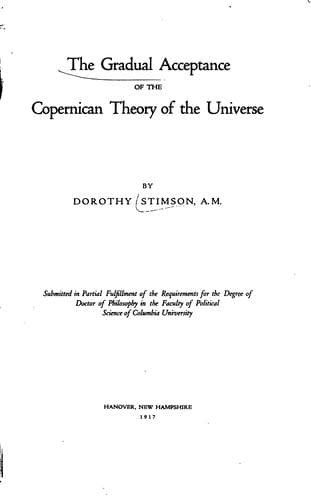
The gradual acceptance of the Copernican theory of the universeStimson, Dorothy
History
The gradual acceptance of the Copernican theory of the universe
Stimson, Dorothy
Astronomy -- History; Copernicus, Nicolaus, 1473-1543; Solar system
During the 18th century at Louvain the Copernican doctrine was warmly
supported, but as a theory. A MS. of a course given there in 1748 has
come down to us, in which the professor, while affirming its
hypothetical character, described it as a simple, clear and
satisfactory explanation of the phenomena, then answered all the
objections made against it by theologians, physicists, and
astronomers.[403] A few years earlier, (1728) a Jesuit at Liège,
though well acquainted with Newton's work, declared: "For my part I do
not doubt the least in the world that the earth is eternally fixed,
for God has founded the terrestrial globe, and it will not be
shaken."[404] Another priest stated in the first chapter of his
astronomy that the sun and the planets daily revolve around the earth;
then later on, he explained the Copernican and the Tychonic schemes
and the Cartesian theory of motion with evident sympathy.[405] Two
others, one a Jesuit in 1682 at Naples,[406] the other in 1741 at
Verona, frankly preferred the Tychonic system, and the latter called
the system found by "Tommaso Copernico" a mere fancy.[407] Still
another priest, evidently well acquainted with Bradley's work, as late
as in 1774 declared that there was nothing decisive on either side of
the great controversy between the systems.[408] At this time, however,
a father was teaching the Copernican system at Liège without
differentiating between thesis and hypothesis.[409] And a Jesuit,
while he denied (1772) universal gravitation, the earth's movement,
and the plurality of inhabited worlds, declared that the Roman
Congregation had done wrong in charging these as heretical
suggestions. In fact, M. Monchamp, himself a Catholic priest at
Louvain, declared that the Newtonian proofs were considered by many in
the 18th century virtually to abrogate the condemnation of 1616 and
1633; hence the professors of the seminary at Liège had adopted the
Copernican system.[410]
[Footnote 403: Ibid: 326.]
[Footnote 404: Ibid: 330.]
[Footnote 405: Fontana: _Institutio_, II, 32-35.]
[Footnote 406: Ferramosca: _Positiones ..._: 19.]
[Footnote 407: Piccoli: _La Scienza_, 4, 7.]
[Footnote 408: Spagnio, _De Motu_, 81.]
[Footnote 409: Monchamp: 331.]
[Footnote 410: Monchamp: 345.]
Public-domain text, read in full here on John Shaqi.
Reviews
Reviews
No reviews yet
Be the first to share your thoughts on this work.
Elsewhere in the archive
Join the Discussion
Join the discussion
Sign in to leave a comment or review.
Sign InorCreate an account