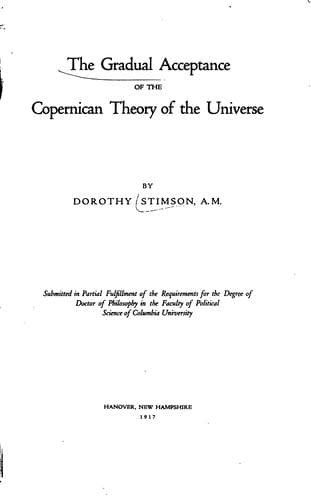
The gradual acceptance of the Copernican theory of the universeStimson, Dorothy
History
The gradual acceptance of the Copernican theory of the universe
Stimson, Dorothy
Astronomy -- History; Copernicus, Nicolaus, 1473-1543; Solar system
The famous French astronomer Lalande, in Rome in 1757 when the
Inquisition first modified its position, tried to persuade the
authorities to remove Galileo's book also from the Index; but his
efforts were unavailing, because of the sentence declared against its
author.[411] In 1820 Canon Settele was not allowed by the Master of
the Sacred Palace to publish his textbook because it dealt with the
forbidden subject. His appeal to the Congregation itself resulted, as
we have seen, in the decree of 1822 removing this as a cause for
prohibition. Yet as late as in 1829, when a statue to Copernicus was
being unveiled at Warsaw, and a great convocation had met in the
church for the celebration of the mass as part of the ceremony, at the
last moment the clergy refused in a body to attend a service in honor
of a man whose book was on the Index.[412]
[Footnote 411: Bailly: II, 132, note.]
[Footnote 412: Flammarion: 196-198.]
Thus the Roman Catholic Church by reason of its organization and of
its doctrine requiring obedience to its authority was more conspicuous
for its opposition as a body to the Copernican doctrine, even though
as individuals many of its members favored the new system. But the
Protestant leaders were quite as emphatic in their denunciations,
though less influential because of the Protestant idea of the right to
individual belief and interpretation. Luther, Melancthon, Calvin,
Turrettin,[413] Owen, and Wesley are some of the notable opponents to
it. And when the scientific objections had practically disappeared,
those who interpreted the Scriptures literally were still troubled and
hesitant down to the present day. Not many years ago, people flocked
to hear a negro preacher of the South, Brother Jasper, uphold with all
his ability that the sun stood still at Joshua's command, and that
today "the sun do move!" Far more surprising is this statement in the
new _Catholic Encyclopedia_ under "Faith," written by an English
Dominican:
"If, now, the will moves the intellect to consider some
debatable point--_e.g._, the Copernican and Ptolemaic
theories of the relationship between the sun and the
earth--it is clear that the intellect can only assent to one
of these views in proportion that it is convinced that the
particular view is true. But neither view has, as far as we
can know, more than probable truth, hence of itself the
intellect can only give in its partial adherence to one of
these views, it must always be precluded from absolute
assent by the possibility that the other may be right. The
fact that men hold more tenaciously to one of these than the
arguments warrant can only be due to some extrinsic
consideration, _e.g._, that it is absurd not to hold to what
a vast majority of men hold."
[Footnote 413: Shields: 60.]
Public-domain text, read in full here on John Shaqi.
Reviews
Reviews
No reviews yet
Be the first to share your thoughts on this work.
Elsewhere in the archive
Join the Discussion
Join the discussion
Sign in to leave a comment or review.
Sign InorCreate an account