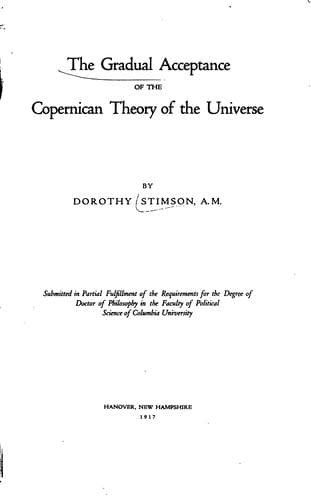
The gradual acceptance of the Copernican theory of the universeStimson, Dorothy
History
The gradual acceptance of the Copernican theory of the universe
Stimson, Dorothy
Astronomy -- History; Copernicus, Nicolaus, 1473-1543; Solar system
"But friends, in truth, have brought me forth into the light again,
though I long hesitated and am still reluctant; among these the
foremost was Nicholas Schönberg, Cardinal of Capua, celebrated in all
fields of scholarship. Next to him is that scholar, my very good
friend, Tiedeman Giese, Bishop of Culm, most learned in all sacred
matters, (as he is), and in all good sciences. He has repeatedly urged
me and, sometimes even with censure, implored me to publish this book
and to suffer it to see the light at last, as it has lain hidden by me
not for nine years alone, but also into the fourth 'novenium'. Not a
few other scholars of eminence also pleaded with me, exhorting me that
I should no longer refuse to contribute my book to the common service
of mathematicians on account of an imagined dread. They said that
however absurd in many ways this my doctrine of the earth's motion
might now appear, so much the greater would be the admiration and
goodwill after people had seen by the publications of my commentaries
the mists of absurdities rolled away by the most lucid demonstrations.
Brought to this hope, therefore, by these pleaders, I at last
permitted my friends, as they had long besought me, to publish this
work.
"But perhaps your Holiness will not be so shocked that I have dared to
bring forth into the light these my lucubrations, having spent so much
work in elaborating them, that I did not hesitate even to commit to a
book my conclusions about the earth's motion, but that you will
particularly wish to hear from me how it came into my mind to dare to
imagine any motion of the earth, contrary to the accepted opinion of
mathematicians and in like manner contrary to common sense. So I do
not wish to conceal from your Holiness that nothing else moved me to
consider some other explanation for the motions of the spheres of the
universe than what I knew, namely that mathematicians did not agree
among themselves in their examinations of these things. For in the
first place, they are so completely undecided concerning the motion of
the sun and of the moon that they could not observe and prove the
constant length of the great year.[440] Next, in determining the
motions of both these and the five other planets, they did not use the
same principles and assumptions or even the same demonstrations of the
appearances of revolutions and motions. For some used only homocentric
circles; others, eccentrics and epicycles, which on being questioned
about, they themselves did not fully comprehend. For those who put
their trust in homocentrics, although they proved that other diverse
motions could be derived from these, nevertheless they could by no
means decide on any thing certain which in the least corresponded to
the phenomena. But these who devised eccentrics, even though they seem
for the most part to have represented apparent motions by a number [of
eccentrics] suitable to them, yet in the meantime they have admitted
Public-domain text, read in full here on John Shaqi.
Reviews
Reviews
No reviews yet
Be the first to share your thoughts on this work.
Elsewhere in the archive
Join the Discussion
Join the discussion
Sign in to leave a comment or review.
Sign InorCreate an account