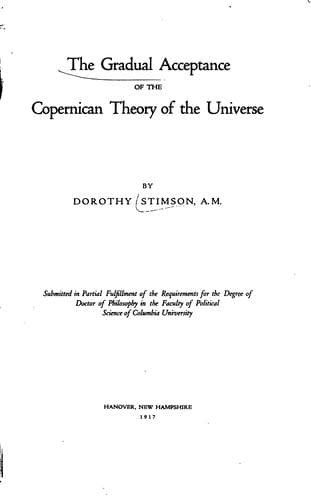
The gradual acceptance of the Copernican theory of the universeStimson, Dorothy
History
The gradual acceptance of the Copernican theory of the universe
Stimson, Dorothy
Astronomy -- History; Copernicus, Nicolaus, 1473-1543; Solar system
quite a few which appear to contravene the first principles of
equality of motion. Another notable thing, that there is a definite
symmetry between the form of the universe and its parts, they could
not devise or construct from these; but it is with them as if a man
should take from different places, hands, feet, a head and other
members, in the best way possible indeed, but in no way comparable to
a single body, and in no respect corresponding to each other, so that
a monster rather than a man would be constructed from them. Thus in
the process of proof, which they call a system, they are found to have
passed over some essential, or to have admitted some thing both
strange and scarcely relevant. This would have been least likely to
have happened to them if they had followed definite principles. For if
the hypotheses they assumed were not fallacious, everything which
followed out of them would have been verified beyond a doubt. However
obscure may be what I now say, nevertheless in its own place it will
be made more clear.
[Footnote 440: _i.e._, the 15,000 solar years in which all the
heavenly bodies complete their circuits and return to their original
positions.]
"When therefore I had long considered this uncertainty of traditional
mathematics, it began to weary me that no more definite explanation of
the movement of the world machine established in our behalf by the
best and most systematic builder of all, existed among the
philosophers who had studied so exactly in other respects the minutest
details in regard to the sphere. Wherefore I took upon myself the task
of re-reading the books of all the philosophers which I could obtain,
to seek out whether any one had ever conjectured that the motions of
the spheres of the universe were other than they supposed who taught
mathematics in the schools. And I found first that, according to
Cicero, Nicetas had thought the earth was moved. Then later I
discovered according to Plutarch that certain others had held the
same opinion; and in order that this passage may be available to all,
I wish to write it down here:
"But while some say the earth stands still, Philolaus the
Pythagorean held that it is moved about the element of fire
in an oblique circle, after the same manner of motion that
the sun and moon have. Heraclides of Pontus and Ecphantus
the Pythagorean assign a motion to the earth, not
progressive, but after the manner of a wheel being carried
on its own axis. Thus the earth, they say, turns itself upon
its own center from west to east."[441]
[Footnote 441: Plutarch: _Moralia: De Placitis Philosophorum_, Lib.
III, c. 13 (V. 326).]
Public-domain text, read in full here on John Shaqi.
Reviews
Reviews
No reviews yet
Be the first to share your thoughts on this work.
Elsewhere in the archive
Join the Discussion
Join the discussion
Sign in to leave a comment or review.
Sign InorCreate an account