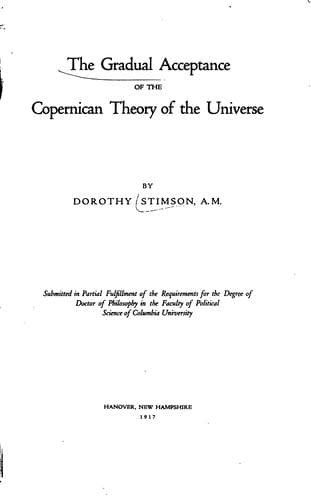
The gradual acceptance of the Copernican theory of the universeStimson, Dorothy
History
The gradual acceptance of the Copernican theory of the universe
Stimson, Dorothy
Astronomy -- History; Copernicus, Nicolaus, 1473-1543; Solar system
[Illustration: A photographic facsimile (reduced) of a page from
Mulier's edition (1617) as "corrected" according to the _Monitum_ of
the Congregations in 1620. The first writer merely underlined the
passage with marginal comment that this was to be deleted by
ecclesiastical order. The second writer scratched out the passage and
referred to the second volume of Riccioli's _Almagestum Novum_ for the
text of the order. The earlier writer was probably the librarian of
the Florentine convent from which this book came, and wrote this soon
after 1620. The later writer did his work after 1651, when Riccioli's
book was published. This copy of the _De Revolutionibus_ is now in the
Dartmouth College Library.]
If perchance there should be foolish speakers who, together with those
ignorant of all mathematics, will take it upon themselves to decide
concerning these things, and because of some place in the Scriptures
wickedly distorted to their purpose, should dare to assail this my
work, they are of no importance to me, to such an extent do I despise
their judgment as rash. For it is not unknown that Lactantius, the
writer celebrated in other ways but very little in mathematics, spoke
somewhat childishly of the shape of the earth when he derided those
who declared the earth had the shape of a ball.[442] So it ought not
to surprise students if such should laugh at us also. Mathematics is
written for mathematicians to whom these our labors, if I am not
mistaken, will appear to contribute something even to the
ecclesiastical state the headship of which your Holiness now occupies.
For it is not so long ago under Leo X when the question arose in the
Lateran Council about correcting the Ecclesiastical Calendar. It was
left unsettled then for this reason alone, that the length of the year
and of the months and the movements of the sun and moon had not been
satisfactorily determined. From that time on, I have turned my
attention to the more accurate observation of these, at the suggestion
of that most celebrated scholar, Father Paul, a bishop from Rome, who
was the leader then in that matter. What, however, I may have achieved
in this, I leave to the decision of your Holiness especially, and to
all other learned mathematicians. And lest I seem to your Holiness to
promise more about the value of this work than I can perform, I now
pass on to the undertaking.
[Footnote 442: These two sentences the Congregations in 1620 ordered
struck out, as part of their "corrections."]
APPENDIX C.
THE DRAMA OF UNIVERSAL NATURE: in which are considered the
efficient causes and the ends of all things, discussed in a
connected series of five books, by JEAN BODIN, (Frankfort,
1597).
_Book V_: On the Celestial Bodies: their number, movement,
size, harmony and distances compared with themselves and
with the earth. Sections 1 and 10 (in part) and 12
(entire).
Public-domain text, read in full here on John Shaqi.
Reviews
Reviews
No reviews yet
Be the first to share your thoughts on this work.
Elsewhere in the archive
Join the Discussion
Join the discussion
Sign in to leave a comment or review.
Sign InorCreate an account