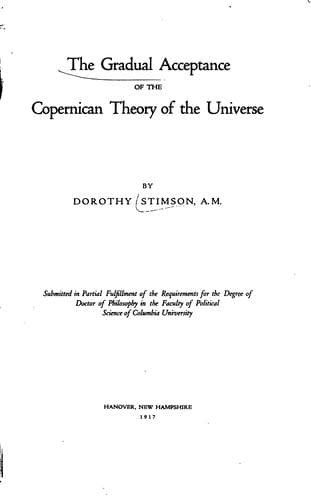
The gradual acceptance of the Copernican theory of the universeStimson, Dorothy
History
The gradual acceptance of the Copernican theory of the universe
Stimson, Dorothy
Astronomy -- History; Copernicus, Nicolaus, 1473-1543; Solar system
BODIN, JEAN: _Universæ Naturæ Theatrum in quo rerum omnium
effectrices causa et fines contemplantur, et continuæ series
quinque libris discutiuntur_. Frankfort, 1597. Book V
translated into English by the writer and compared with the
French translation by François de Fougerolles, (Lyons,
1597).
_Section 1_: On the definition and the number of the spheres.
MYSTAGOGUE: ... Now to prove that the heavens have a nature endowed
with intelligence I need no other argument than that by which
Theophrastus and Alexander prove they are living, for, they say, if
the heavens did not have intelligence, they would be greatly inferior
in dignity and excellence to men. That is why Aben-Ezra,[443] having
interpreted the Hebrew of these two words of the Psalm: "The heavens
declare," has written that the phrase _Sapperim_ (declare) in the
judgment of all Hebrews is appropriate to such great intelligence.
Also he who said "When the morning stars sang together and shouted for
joy,"[444] indicated a power endowed with intelligence, as did the
Master of Wisdom[445] also when he said that God created the heavens
with intelligence.
[Footnote 443: As Rabbi David testified on the 19th Psalm [these
footnotes are by Bodin].]
[Footnote 444: Job: 38.]
[Footnote 445: Proverbs.]
THEODORE. I have learned in the schools that the spheres are not moved
of themselves but that they have separate intelligences who incite
them to movement.
MYST. That is the doctrine of Aristotle. But Theophrastus and
Alexander,[446] (when they teach that the spheres are animated bodies)
explain adequately that the spheres are agitated by their own
coëssential soul. For if the sky were turned by an intelligence
external to it, its movement would be accidental with the result that
it, and the stars with it, would not be moved otherwise, than as a
body without soul. But accidental motion is violent. And nothing
violent in nature can be of long duration. On the contrary there is
nothing of longer duration, nor more constant, than the movement of
the heavens.
[Footnote 446: Metaphysics: II. c. 6, de Coelo. I. c. 6.]
THEO. What do you call fixed stars?
Public-domain text, read in full here on John Shaqi.
Reviews
Reviews
No reviews yet
Be the first to share your thoughts on this work.
Elsewhere in the archive
Join the Discussion
Join the discussion
Sign in to leave a comment or review.
Sign InorCreate an account