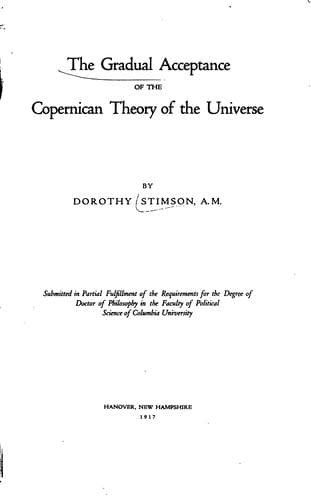
The gradual acceptance of the Copernican theory of the universeStimson, Dorothy
History
The gradual acceptance of the Copernican theory of the universe
Stimson, Dorothy
Astronomy -- History; Copernicus, Nicolaus, 1473-1543; Solar system
MYST. Celestial beings who are gifted with intelligence and with
light, and who are in continual motion. This is sufficiently indicated
by the words of Daniel[447] when he wrote, that the souls of those who
have walked justly in this life, and who have brought men back to the
path of virtue, all have their seat and dwelling (like the gleaming
stars) among the heavens. By these words one can plainly understand
the essence and figure of the angels as well as of the celestial
beings; for while other beings have their places in this universe
assigned to them for their habitation, as the fish the sea, the cattle
the fields, and the wild beasts the mountains and forests, even as
Origen,[448] Eusebius, and Diodorus say, so the stars are assigned
positions in the heavens. This can also be understood by the curtains
of the tabernacle which Moses, the great Lawgiver, had ornamented with
the images of cherubim showing that the heavens were indicated by the
angelic faces of the stars. While St. Augustine,[449] Jerome,[450]
Thomas Aquinas[451] and Scotus most fitly called this universe a
being, nevertheless Albertus, Damascenus, and Thomas Aquinas deny that
the heavenly bodies are animated. But Thomas Aquinas shows himself in
this inconsistent and contradictory, for he confesses that spiritual
substances are united with the heavenly bodies, which could not be
unless they were united in the same hypostasis of an animated body. If
this body is animated, it must necessarily be living and either
rational or irrational. If, on the other hand, this spiritual
substance does not make the same hypostasis with the celestial body,
it will necessarily be that the movement of the sky is accidental, as
coming from the mover outside to the thing moved, no more nor less
than the movement of a wheel comes from the one who turns it: As this
is absurd, what follows from it is necessarily absurd also.
[Footnote 447: In his last chapter.]
[Footnote 448: Which is confirmed by Pico of Mirandola: Heptaplus: Bk.
V.]
[Footnote 449: Enchiridion: cap. 43; Gen.: 2 and 18.]
[Footnote 450: On Psalm: Audite coeli.]
[Footnote 451: Summa: pt. 1, art. 3, ques. 70.]
THEO. How many spheres are there?
Public-domain text, read in full here on John Shaqi.
Reviews
Reviews
No reviews yet
Be the first to share your thoughts on this work.
Elsewhere in the archive
Join the Discussion
Join the discussion
Sign in to leave a comment or review.
Sign InorCreate an account