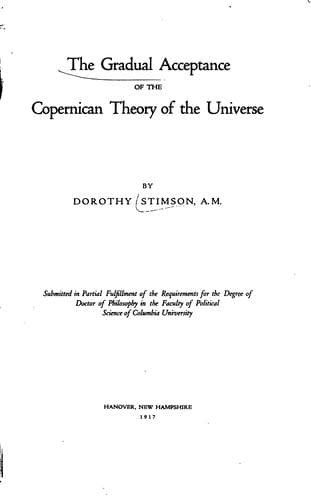
The gradual acceptance of the Copernican theory of the universeStimson, Dorothy
History
The gradual acceptance of the Copernican theory of the universe
Stimson, Dorothy
Astronomy -- History; Copernicus, Nicolaus, 1473-1543; Solar system
MYST. It can indeed be proved that there are ten mobile spheres in
which the fiery bodies accomplish their regular courses. Yet by these
arguments that ultimate, motionless sphere which embraces and
encircles all from our terrestial abode to its circumference within
its crystalline self, encompassing plainly the utmost shores and
limits of the universe, cannot be proved. For as it has been shown
before [in Book I] the elemental world was inundated by celestial
waters from above. Nor can it apparently be included in the number of
the spheres since (as we will point out later) as great a distance
exists between it and the nearest sphere as between the ocean and the
starry heaven. Furthermore it has been said before that the essence
of the spheres consists of fire and water which is not fitting for the
celestial waters above.
THEO. By what arguments then can it be proved there are ten spheres?
MYST. The ancients knew well that there were the seven spheres of the
planets, and an eighth sphere of the fixed stars which, down to the
time of Eudoxus and Meto, they thought had but one simple movement.
These men were the first who perceived by observation that the fixed
stars were carried backward quite contrary to the movement of the
Primum Mobile. After them came Timochares, Hipparchus, and Menelaus,
and later Ptolemy, who confirmed these observations perceiving that
the fixed stars (which people had hitherto thought were fixed in their
places) had been separated from their station. For this reason they
thought best to add a ninth sphere to the eight inferior ones. Much
later an Arabian and a Spanish king, Mensor and Alphonse, great
students of the celestial sciences, in their observations noticed that
the eighth sphere with the seven following moved in turning from the
north to the east, then towards the south, and so to the west, finally
returning to the north, and that such a movement was completed in 7000
years. This Johannus Regiomontanus, a Franconian, has proved, with a
skill hitherto equalled only by that of those who proved the ninth
sphere, which travels from west to east. From this it is necessarily
concluded that there are ten spheres.
THEO. Why so?
MYST. Because every natural body[455] has but one movement which is
its own by nature; all others are either voluntary or through
violence, contrary to the nature of a mobile object; for just as a
stone cannot of its own impulse ascend and descend, so one and the
same sphere cannot of itself turn from the east to the west and from
the west to the east and still less from the north to the south and
south to north.
[Footnote 455: Aristotle: Metaph. II and XII and de Coelo I.]
THEO. What then?
Public-domain text, read in full here on John Shaqi.
Reviews
Reviews
No reviews yet
Be the first to share your thoughts on this work.
Elsewhere in the archive
Join the Discussion
Join the discussion
Sign in to leave a comment or review.
Sign InorCreate an account