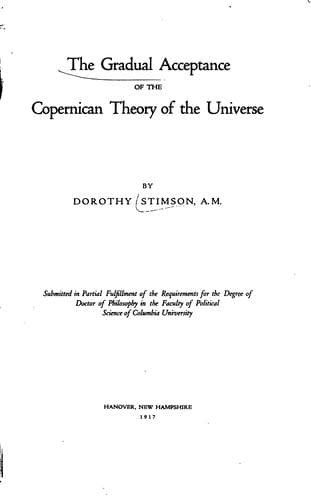
The gradual acceptance of the Copernican theory of the universeStimson, Dorothy
History
The gradual acceptance of the Copernican theory of the universe
Stimson, Dorothy
Astronomy -- History; Copernicus, Nicolaus, 1473-1543; Solar system
MYST. It follows from this that the extremely rapid movement by which
all the spheres are revolved in twenty-four hours, belongs to the
Primum Mobile, which we call the tenth sphere, and which carries with
it all the nine lesser spheres; that the second or planetary movement,
that is, from west to east, is communicated to the lesser spheres and
belongs to the ninth sphere; that the third movement, resembling a
person staggering, belongs to the eighth sphere with which it affects
the other lesser spheres and makes them stagger in a measure outside
of the poles, axes and centres of the greater spheres.
_Section 10_: On the position of the universe according to its
divisions.
* * * *
THEO. Does it not also concern Physics to discuss those things that
lie outside the universe?
MYST. If there were any natural body beyond the heavens, most
assuredly it would concern Physics, that is, the observer and student
of nature. But in the book of Origins,[456] the Master workman is said
to have separated the waters and placed the firmament in between them.
The Hebrew philosophers declare that the crystalline sphere which
Ezekiel[457] called the great crystal and upon which he saw God
seated, as he wrote, is as far beyond the farthermost heaven as our
ocean is far from that heaven, and that this orb is motionless and
therefore is called God's throne. For "seat" implies quiet and
tranquility which could be proper for none other than the one immobile
and immutable God. This is far more probable and likely than
Aristotle's absurd idea, unworthy the name of a philosopher, by which
he placed the eternal God in a moving heaven as if He were its source
of motion and in such fashion that He was constrained of necessity to
move it. We have already refuted this idea. It has also been shown
that these celestial waters full of fertility and productiveness
sometimes are spread abroad more widely and sometimes less so, as
though obviously restrained, whence the heavens are said to be
closed[458] and roofed[459] with clouds or that floods burst forth out
of the heaven to inundate the earth. Finally we read in the Holy
Scriptures that the eternal God is seated upon the flood.
[Footnote 456: Gen.: 1.]
[Footnote 457: Chap. 1 and 10. Exod.: 24.]
[Footnote 458: I Kings: 8. Deut.: 28.]
[Footnote 459: Psalm 146.]
THEO. Why then are not eleven spheres counted?
Public-domain text, read in full here on John Shaqi.
Reviews
Reviews
No reviews yet
Be the first to share your thoughts on this work.
Elsewhere in the archive
Join the Discussion
Join the discussion
Sign in to leave a comment or review.
Sign InorCreate an account