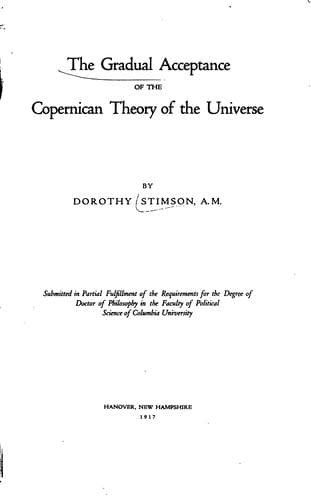
The gradual acceptance of the Copernican theory of the universeStimson, Dorothy
History
The gradual acceptance of the Copernican theory of the universe
Stimson, Dorothy
Astronomy -- History; Copernicus, Nicolaus, 1473-1543; Solar system
MYST. If then the firmament occupies the middle position between the
two waters, then by this hypothesis you must admit that the space
beyond the spheres is empty of elemental and celestial bodies;
otherwise you would have to admit that the last sphere extends on even
to the crystalline orb, which can in no way be reconciled with the
Holy Scriptures and still less with reason because of the incredible
velocity of this sphere. Therefore it is far more probable that this
space is filled with angels.
THEO. Is there some medium between God and the angels which shares in
the nature of both?
MYST. What is incorporeal and indivisible cannot communicate any part
of its essence to another; for if a creature had any part of the
divine essence, it would be all God, since God neither has parts nor
can be divided, therefore He must be separated from all corporeal
contact or intermixture.
_Section 12_: On guardian angels.
THEO. What then in corporeal nature is closest to God?
MYST. The two Seraphim, who stand near the eternal Creator,[467] and
who are said to have six wings, two wherewith to fly, the others to
cover head and feet. By this is signified the admirable swiftness with
which they fulfill His commands, yet head and feet are veiled for so
the purpose of their origin and its earliest beginning are not known
to us. Also they have eyes scattered in all parts of their bodies to
indicate that nothing is hidden from them. And they also pour oil for
lighting through a funnel into the seven-branched candlestick; that
is, strength and power are poured forth by the Creator to the seven
planets, so that we should turn from created things to the worship and
love of the Creator.
[Footnote 467: Isa. 6. Ezek. 1 and 10. Zach. 4. Exod. 24, 25.]
THEO. Since nothing is more fitting for the Divine goodness than to
create, to generate, and to pile up good things for all, whence comes
the destruction of the world and the ruin of all created things?
MYST. It is true Plato and Aristotle attributed the cause of all ills
to the imperfection of matter in which they thought was some
_kakopoion_,[468] but that is absurd since it is distinctly written:
All that God had made was good, or as the Hebrews express it,
beautiful,--so evil is nothing-else than the absence[469] or privation
of good.
[Footnote 468: Maleficium quidam, _i.e._, some evil-power. Job 5.]
[Footnote 469: Augustine against Faustus wrote that vanity is not
produced from the dust, nor evil from the earth.]
THEO. Can not wicked angels be defined without privation since they
are corporeal essences?
Public-domain text, read in full here on John Shaqi.
Reviews
Reviews
No reviews yet
Be the first to share your thoughts on this work.
Elsewhere in the archive
Join the Discussion
Join the discussion
Sign in to leave a comment or review.
Sign InorCreate an account