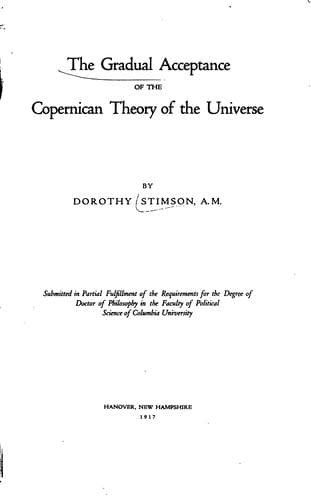
The gradual acceptance of the Copernican theory of the universeStimson, Dorothy
History
The gradual acceptance of the Copernican theory of the universe
Stimson, Dorothy
Astronomy -- History; Copernicus, Nicolaus, 1473-1543; Solar system
MYST. Anything that exists is said to be good and to be a participant
by its existence in the divine goodness; and even as in a well
regulated Republic, executioners, lictors, and corpse-bearers are no
less necessary than magistrates, judges and overseers; so in the
Republic of this world, for the generation, management and
guardianship of things God has gathered together angels as leaders and
directors for all the celestial places, for the elements, for living
beings, for plants, for minerals, for states, provinces, families and
individuals. And not only has He done this, but He has also assigned
His servants, lictors, avengers and others to places where they may do
nothing without His order, nor inflict any punishment upon wicked men
unless the affair has been known fully and so decided. Thus God is
said[470] to have made Leviathan, which is the outflow of Himself,
that is, the natural rise and fall of all things. "I have created a
killer,"[471] He said, "to destroy," and so also Behemoth, and the
demons cleaving to him, which are often called ravens, eagles and
lions, and which are said to beg their food of God, that is, the
taking of vengeance upon the wicked whose punishment and death they
feed upon as upon ordinary fare. From these, therefore, or rather from
ourselves, come death, pestilence, famine, war and those things we
call ills, and not from the Author of all good things except by
accident. For so God says of Himself:[472] "I am the God making good
and creating evil, making light and creating darkness." For when He
withdraws His spirit, evil follows the good; when He takes the light
away, darkness is created; as when one removes the pillars of a
building, the ruin of a house follows. If He takes the vital spark
away, death follows; nor can He be said to do evil[473] to anyone in
taking back what is His own.
[Footnote 470: Job 41 and 49. Isa. 54. Ezek. 31.]
[Footnote 471: Isa. 54.]
[Footnote 472: Isa. 45.]
[Footnote 473: Job 34.]
THEO. When the Legislator asked Him to disclose His face to his gaze,
why did the Architect of the universe and the Author of all things
reply: "My face is to be seen by no mortal man, but only my back?"
Public-domain text, read in full here on John Shaqi.
Reviews
Reviews
No reviews yet
Be the first to share your thoughts on this work.
Elsewhere in the archive
Join the Discussion
Join the discussion
Sign in to leave a comment or review.
Sign InorCreate an account