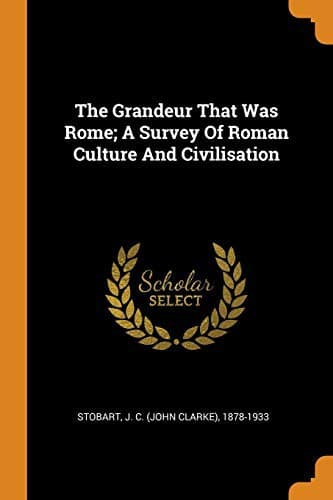
The Grandeur That Was Rome: a survey of Roman culture and civilisationStobart, J. C. (John Clarke)
History
The Grandeur That Was Rome: a survey of Roman culture and civilisation
Stobart, J. C. (John Clarke)
Rome -- Civilization; Rome -- History
The music of this, with its beautiful imagery and refrains, is no
doubt based upon an Alexandrian foundation. There is a distinct echo
of Theocritus. But it is also distinctively Italian, and the greatest
of modern Italian poets, Carducci, writes like a legitimate descendant
of Catullus. Catullus has as little biography as Lucretius. He must
have died at an early age in the fifties B.C. He was a poor man. He
had only a town house and two villas, one on the Lago di Garda and one
at Tivoli. He hated Cæsar and loved Cicero. That his “Lesbia” was the
infamous Clodia is generally asserted. I do not believe it.
These two poets, Lucretius and Catullus, then, stand almost alone as
representatives of Republican Roman literature on the poetical side.
Both are Romanising various Alexandrian Greek modes, but both have
something genuinely Roman, a quality which we may best describe as
virility, to add to their originals. This was the point from which a
genuine Roman literature might have taken its departure. Instead of
that, the next era is that of a courtly school of classicists, largely
writing to order, who gave to Latin its distinctively classical bent.
Cicero, the most classical of all classics, is, however, far the
greatest literary product of the Republic. He is, indeed, far too vast
a figure for these modest pages. By his colossal industry and immense
fertility of genius his influence dominates the whole field of Latin
prose literature. He is not only the greatest of all orators, but
he stands as the type of the orator in life as in literature. We of
this generation, who live in the eclipse of rhetoric, do not find it
easy to be just to him. With such gifts of eloquence, such a power of
uttering tremendous phrases about duty and patriotism, we cannot but
feel affronted at his political incapacity. Mommsen, who is all for
action, peppers him with contemptuous expressions--“a statesman without
insight, opinion or purpose”; “a short-sighted egoist”; “a journalist
of the worst description”; “his lawyer’s talent of finding excuses--or,
at any rate, words--for everything.” And, indeed, among men like Cæsar
with legions at their backs, or creatures like Clodius with their packs
of hooligans, a man of golden words and honest principles does cut a
sorry figure on the pages of history--so much the worse for history! He
had, as we have seen, a policy, his talents made him a leader among the
moderates of the senate, and his character made him genuinely popular
among all the more respectable classes of society. But Rhetoric is one
of the feminine Muses, and Cicero’s nature was as soft and sympathetic
as a woman’s. So he turns his coat at a word from Pompeius, utters
brave words one day and eats them on the next, publishes magnificent
denunciations which he has not had the courage to deliver. Moreover,
we see his intimate thoughts revealed in all the frankness of an
unexpurgated private correspondence--and there are few statesmen,
Public-domain text, read in full here on John Shaqi.
Reviews
Reviews
No reviews yet
Be the first to share your thoughts on this work.
Elsewhere in the archive
Join the Discussion
Join the discussion
Sign in to leave a comment or review.
Sign InorCreate an account