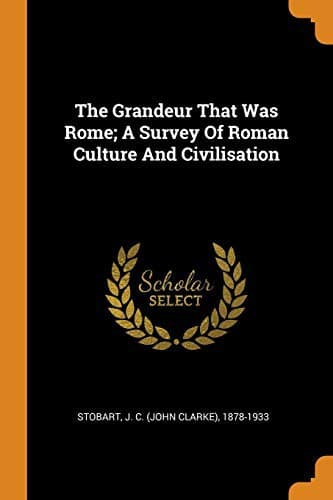
The Grandeur That Was Rome: a survey of Roman culture and civilisationStobart, J. C. (John Clarke)
History
The Grandeur That Was Rome: a survey of Roman culture and civilisation
Stobart, J. C. (John Clarke)
Rome -- Civilization; Rome -- History
Nero’s fall was caused directly by the defection of the prætorian
guards, whose allegiance had been bought in the name of Galba. Nero was
the last member of the Julio-Claudian family, and at his death the last
shadow of dynastic claim passed away. The succession of the principate
became a mere scramble in which the strongest or the luckiest or the
heaviest briber won the day. Pretenders sprang up against Galba,
several of the armies put forward their generals as competitors for the
throne; and Galba himself had not even enough generosity to pay the
bribes by which he had secured his throne. Thus the year 69 was a year
of incessant civil war. Galba was murdered in the streets of Rome; Otho
was defeated in battle near Bedriacum and slain in his camp, Vitellius;
the choice of the legions in Germany, reigned from April to December,
when Rome was once more occupied by a citizen army. The legions of
Syria, seeing that their fellow-soldiers of Spain and Germany had
already made their generals into emperors, had determined to take a
hand in the game, and now Vespasian came as the fourth Cæsar in the
space of a single year.
It speaks well for the solidity of the imperial system as organised by
Augustus that it survived the shock of such events as these. It proves
that the system was everything and the man little or nothing.
The new Emperor Vespasian, who succeeded after all this turmoil, was
different from his predecessors in that he had two grown-up sons
ready to succeed him. It is said that Mucianus, a still more powerful
Eastern general, had surrendered his claims because he was childless.
If so, it was nobly and wisely done. Vespasian was able and willing
to restore the machinery of the Augustan principate. He was himself
frankly a humble Sabine with no claims of birth. He was firm but not
oppressive towards the senate, and he kept control over the prætorian
guard by appointing Titus, his son, to its command. He also established
the succession beyond doubt by making Titus his consort. Vespasian and
Titus were elected consuls year by year. Vespasian’s principal work was
to restore the financial credit of the government. Unfortunately the
two sons, Titus, and then Domitian, who followed him upon the throne
and with him make up the “Flavian” dynasty, were scarcely worthy of
their father. Titus was “the darling of the human race,” generous and
mild to the senators, but too fond of his popularity to be a strong
ruler, and Domitian was a genuine tyrant. With his autocratic system of
rule he was naturally oppressive to the aristocracy, and his name is
in consequence written on the pages of history as that of a monster of
cruelty. Domitian certainly made constitutional changes which rendered
the monarchy a more open fact. He took the consulship for ten years to
come, he became censor and drew up the senate-roll to suit his fancy,
he refused the usual request of the senators that the emperor should
admit that he had no power to condemn a senator to death.
Public-domain text, read in full here on John Shaqi.
Reviews
Reviews
No reviews yet
Be the first to share your thoughts on this work.
Elsewhere in the archive
Join the Discussion
Join the discussion
Sign in to leave a comment or review.
Sign InorCreate an account