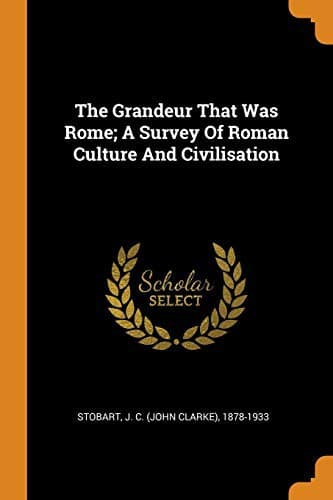
The Grandeur That Was Rome: a survey of Roman culture and civilisationStobart, J. C. (John Clarke)
History
The Grandeur That Was Rome: a survey of Roman culture and civilisation
Stobart, J. C. (John Clarke)
Rome -- Civilization; Rome -- History
The succession to the imperial throne continued to be the weak point
of the whole system. The throne itself passed through unspeakable
degradations. The guards who murdered Pertinax formally put the
succession up to auction in the prætorian camp. Septimius Severus
(193-198) gave a brief respite of strong government which almost
destroyed the fiction of senatorial authority, for Severus held the
proconsular power even over Rome and Italy. Caracalla was probably
the worst of all the emperors in personal vice and brutality, but he
was the author of that famous decree which conferred the citizenship
on all the western provinces. In Elagabalus (218-222) Rome had for
master the vile and effeminate priest of the Sungod, who brought the
fetish-stone of Emesa into the city and attempted to make all the
gods bow down to it. Alexander Severus was a blameless prince, and
Maximin the Thracian drove the barbarians back behind the _limites_
of the Rhine and Danube. After the Gordians the senate enjoyed for a
brief space the opportunity of governing Rome through their nominee
Pupienus, but the disorders of the period may be gauged from the fact
that in the eighteen years following Alexander Severus, who died in
235, twelve persons wore the purple. Then Gallienus assumed it, having
for his colleague that Valerian who was the first of Roman emperors to
be taken prisoner by the enemy. Strange and horrible tales hung about
his mysterious fate when taken captive by Shapur, the Persian king. In
the latter years of Gallienus the Empire was practically divided, for
his rebellious general Postumus was recognised as emperor throughout
Gaul, Spain, and Britain. In this period, too, Palmyra rose into
independent power as the meeting-place of the caravan routes across
the Syrian plains. Under the famous Queen Zenobia it practically ruled
over the eastern parts of the Empire, and its splendid ruins prove its
wealth and magnificence. Gallienus then almost allowed the Empire
to disintegrate under his feeble grasp, but his successor Claudius
Gothicus (268) was a man and a soldier. He smote the Goths and would
have restored the Empire in full, but the plague, which had never
wholly disappeared since the time of Marcus Aurelius, carried him off
in the third year of his reign. The task was left for Aurelian, that
Pannonian peasant whose brilliant generalship hurled back the enemy
on every side, while his statesmanship restored the authority of the
emperor and even the financial credit of the Empire. The mighty wall
with which he surrounded Rome is, however, a sad testimony of the dark
days upon which the imperial city had fallen. The Palmyrene kingdom was
defeated and the rich city plundered. The rebel Empire of the Gauls was
destroyed for ever. The grandest triumph ever witnessed in Rome was
that of Aurelian in 274. It is thus described by Vopiscus:
Public-domain text, read in full here on John Shaqi.
Reviews
Reviews
No reviews yet
Be the first to share your thoughts on this work.
Elsewhere in the archive
Join the Discussion
Join the discussion
Sign in to leave a comment or review.
Sign InorCreate an account