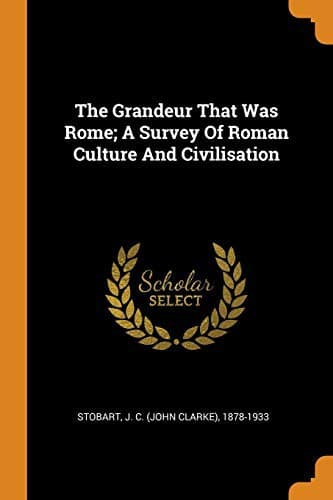
The Grandeur That Was Rome: a survey of Roman culture and civilisationStobart, J. C. (John Clarke)
History
The Grandeur That Was Rome: a survey of Roman culture and civilisation
Stobart, J. C. (John Clarke)
Rome -- Civilization; Rome -- History
It is astonishing how little we really know of Rome and the Romans
after all that has been said and written about them. The ordinary
natural Roman is a complete stranger to us. It is certain that he did
not live in luxury like Mæcenas, but how did he live and what sort
of man was he? We can discern that his language was not in the least
like that of Cicero. It appears that he neither dreaded nor disliked
emperors like Nero, as did Tacitus and Juvenal. As for his religion,
much has already been done, and more still remains to be done, to
show that he did not really worship the Hellenised Olympians who pass
in literature for his gods. Recent scholarship has done something to
reveal to us the presence of a real national art in Rome, or at any
rate of an artistic development on Italian soil which made visible
steps of its own out of Hellenic leading-strings. Thus there is some
hope that the real Roman will not always elude us. But for the present
in the whole domain of art, religion, thought, and literature, Greek
influence has almost obliterated the native strain. For the present,
therefore, we must be content to regard Roman civilisation as mainly
derivative, and our principal object will be to see how Rome fulfilled
her task as the missionary of Greek thought. This object, together
with the unsatisfactory nature of the records, must excuse the haste
with which I have passed over the earlier stages of Roman republican
history. It is obvious that the first three centuries of our era will
be the important part of Roman history from this point of view. Also,
if the progress of civilisation be our main study, nothing in Roman
history before the beginning of the second century B.C. can come
directly under our attention. When the Romans first came into contact
with the Greeks they were still barbarians, with no literature, no art,
and very little industry or commerce. The earlier periods will only be
introductory.
ITALY AND THE ROMAN
The pleasant land of Italy needs no description here. Our
illustrations[2] will recall its sunny hill-sides, its deep shadows,
its vineyards and olive-yards. But there are one or two features of its
geography which have a bearing upon the history of Rome.
Public-domain text, read in full here on John Shaqi.
Reviews
Reviews
No reviews yet
Be the first to share your thoughts on this work.
Join the Discussion
Join the discussion
Sign in to leave a comment or review.
Sign InorCreate an account