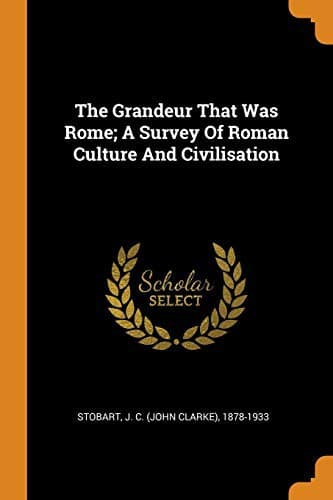
The Grandeur That Was Rome: a survey of Roman culture and civilisation — John Shaqi
The Grandeur That Was Rome: a survey of Roman culture and civilisationStobart, J. C. (John Clarke)
History
The Grandeur That Was Rome: a survey of Roman culture and civilisation
Stobart, J. C. (John Clarke)
Rome -- Civilization; Rome -- History
These city-states had no means of ruling otherwise than tyrannically.
Their whole constitution forbade it. We have seen elsewhere[8] that
citizenship in a city-state implied membership of a corporate body,
a close partnership in a company of unlimited liability with very
definite privileges and responsibilities. Full citizenship at Rome
meant a vote in electing the city magistrates and a vote in the
_comitium_, which decided matters like peace and war. It was obvious
that you had to be very jealous about extending these rights to
outsiders. But Rome went part of the way, granted parts of the citizen
rights, and thereby showed finer imperial statecraft than any Greek
state had yet discovered. Her first offshoot was Ostia, the town she
planted at the mouth of her river only fifteen miles off, her first
_Colonia_. The men of Ostia remained citizens of Rome, and might vote
in the elections if they thought it worth while, but were exempt
from the duty of serving in the army because their own town formed a
standing garrison in the Roman service. Then when the Romans made
conquests in Etruria or Campania or any region where the natives spoke
a foreign language and therefore could not fight in the legions under
Roman officers, they would receive the “citizenship without vote,”
which enabled them simply to trade and marry like Romans. Thirdly, some
of the Latin towns became merely _municipia_, that is, country towns
enjoying full Roman citizenship if they came to the city, but at home
a local constitution with considerable powers of self-government and a
magistracy modelled on that of Rome, namely, senators and consuls under
other names. All this granting of rights--without any tribute--was,
according to the ways of ancient city-states, surprising generosity or
the deepest statesmanship. Already Rome begins to show the genius of
empire-building: she was relentless and unscrupulous in conquering,
but generous and broad-minded in governing. Such was the wisdom of her
council of despots--the Senate.
Public-domain text, read in full here on John Shaqi.
Reviews
Reviews
No reviews yet
Be the first to share your thoughts on this work.
Join the Discussion
Join the discussion
Sign in to leave a comment or review.
Sign InorCreate an account