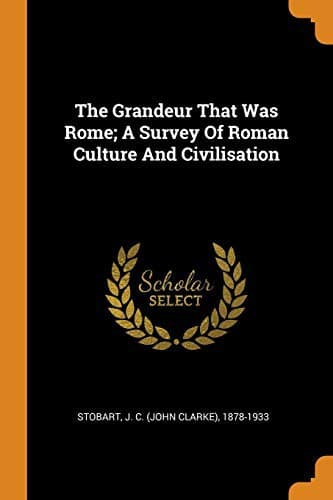
The Grandeur That Was Rome: a survey of Roman culture and civilisationStobart, J. C. (John Clarke)
History
The Grandeur That Was Rome: a survey of Roman culture and civilisation
Stobart, J. C. (John Clarke)
Rome -- Civilization; Rome -- History
The character of the ancient Roman is best described by his favourite
virtue of _gravitas_. In that word is implied serious purpose,
dignified reserve, fidelity to one’s promise, and a sense of duty.
Levity is its opposite, and among the things repugnant to true Roman
gravity were art, music, and literature. It is on the battlefield, in
the senate-house, and the law-courts that the old Roman is most truly
at home.
II
CONQUEST
quæ neque Dardanus campis potuere perire
nec quom capta capi, nec quom combusta cremari,
augusto augurio postquam incluta condita Roma est.
ENNIUS.
[Illustration: This is a block letter “T”]
The great Samnite wars, which had lasted on and off from 343 to 290
B.C., had been the school of Roman valour. In her citizen legions
Rome had evolved a fighting machine unequalled, probably, until the
Musketeers of Louis XIV. and Marlborough. Also she was learning
politics and the art of government. She was now mistress over the
greater part of Italy; all, in fact, except the Gallic plain in the
north and the Greek cities of the south. The Pyrrhic war which followed
after a short breathing-space forms the transition between domestic
expansion and foreign conquest. Our business here is not with wars
and battles for their own sake, but it will be important to observe
in what manner Rome was launched on her career of empire-making.
Seeley has shown how the British Empire grew up in a haphazard manner,
without any wise policy to direct its growth, with continual neglect
of opportunities, and often in contemptuous ignorance of the work that
private citizens were undertaking for its honour and advancement.
We shall see that it was very much the same with the Roman Empire.
One responsibility leads to another, one conquest leads to many
entanglements: if the coast is to be held the hinterland must be
conquered. Thus power follows capacity, and the doctrine which seems
so unjust, “To him that hath shall be given, from him that hath not
shall be taken away even that which he seemeth to have,” is fulfilled
in all the dealings between Providence and imperial peoples. By coming
into contact with the Greeks of the south Rome was brought definitely
to deal with a superior but declining civilisation. The career of
Agathocles, the brigand tyrant of Sicily, had lately shown how easy a
thing it was to make empires among the opulent and luxurious cities of
the Calabrian and Bruttian shores.
Public-domain text, read in full here on John Shaqi.
Reviews
Reviews
No reviews yet
Be the first to share your thoughts on this work.
Join the Discussion
Join the discussion
Sign in to leave a comment or review.
Sign InorCreate an account