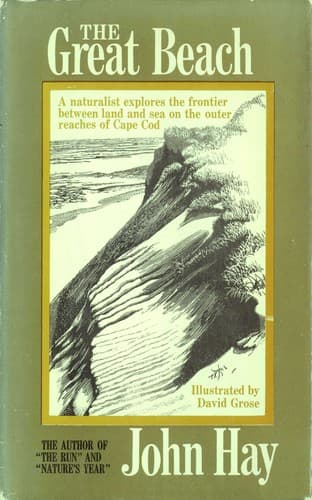
Cape Cod (Mass.) -- Description and travel; Natural history -- Massachusetts -- Cape Cod
On the beach you might see a lone dragger lifting and falling, moving
slowly parallel to the shore, beyond the measured fall of the green
surf. A herring gull flies by. The vast sky swings overhead; the wind
flies down the sand. Purple stones, driftwood, an occasional dead skate
or dogfish comes to your attention as you walk on. A black crow pecks
at seaweed far ahead. A sanderling flits by. You notice a finger sponge
attached to a large mussel or a sea scallop, broken loose and washed
in from offshore beds, and that seems to be all, in a relatively empty
world; but between these single things, a grain of sand, a stone, a
bird or bird track, a wave, you become conscious of a bounty of space.
The sea and its shores are still not caught, still relatively immune to
human claims. Fill them with knowledge and with crowds and they still
escape us, outrunning us like the sunlight on the water. Specifically,
this age which is able to measure everything but mystery, might tell
you just how capacious the oceans are. They comprise two thirds of the
earth’s surface; they have a close relationship to the atmosphere and
are in large measure responsible for our weather; and we know, with the
assurance of conquerors, that if all else fails we may be able to save
the human race from dying of thirst and starvation by extracting water
and food from them, providing our atomic wastes do not prohibit it. We
are also learning how to mine the ocean floors for their minerals, how
to harness the tides, and how to use their depths for concealment.
Oceanography is one of the great modern sciences and it has revealed
mountains, rifts, plains, and canyons on a scale that would astonish us
if we saw them on earth, as it has also brought us more knowledge of
marine animals at all depths. It has made great contributions to the
restless modern mind. How can we look at the sea without at some time
thinking of our earth’s submerged geology, gigantic, uneroded by wind,
sun, or rain, in calm waters inhabited by strange aquatic lives?
Strange is still the word for them. No amount of assessment of the
sea’s contents quite translates them for us. What, for example, is a
fish? What is that flat creature the skate lying there on the sand,
with its tough hide and the small slit of a mouth on the same side as
its belly?
There is an aquarium at Woods Hole with a collection of many of the
kinds of fish that inhabit the waters off Cape Cod. They seem foreign,
weird, almost unexampled when you see them in their captured state. I
saw a woman standing in front of one of the windows looking at some
toadfish, little fat animals with great mouths, squat, with round-edged
fleshy fins that gave the appearance of warts and knobs, expertly
camouflaged in varied patterns so that they can at once sink in and
become a part of the bottom: “Oh!” she cried. “Horrible!”
Public-domain text, read in full here on John Shaqi.
Reviews
Reviews
No reviews yet
Be the first to share your thoughts on this work.
Join the Discussion
Join the discussion
Sign in to leave a comment or review.
Sign InorCreate an account