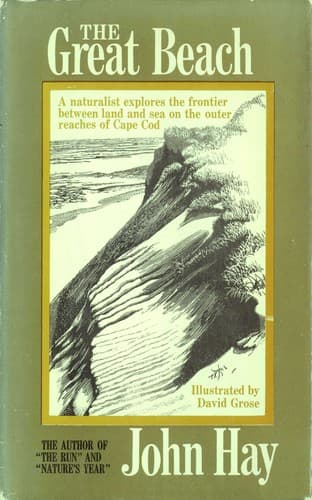
Cape Cod (Mass.) -- Description and travel; Natural history -- Massachusetts -- Cape Cod
Even the alewives, which migrate by the hundred thousands, are only
suggestive of the far running but hidden nature of the oceanic depths.
Most of us, failing a glass-bottom boat or a glass-sided submarine,
have to stand on the beach and take in the vast motions of the sea
surface with only the vaguest idea of what is happening below.
Sometimes it looks like a bowl of dazzling, dashing light, and at
others a gray, monotonous range under a raw wind with white-groined
waves constantly moving across its distances. The sea takes all the
light and air, the storms, clouds, moon, and stars, in endless, various
reflections over its watery reaches, with a monumental acceptance.
Are there not a thousand ways to describe the sea which in their sum
amount to inscrutability? How can you translate its abundance even by
counting so many thousands of protozoa in a drop of water? Who can
fathom the range of appetite it contains, the ferocity of the life its
amplitude allows?
One day in early fall I traveled from the Cape with a party of people
in a chartered boat, heading for an area some ten or fifteen miles
out. The offshore breezes coasted over smooth, sun-bright waters that
carried some of the land’s litter with them, sticks, leaves, petals,
and even butterflies. At one point a dragonfly skimmed past us; and
silky seeds of milkweed and dandelions went sailing and twisting by to
land eventually where they could never take root. Farther out, oceanic
birds like jaegers, shearwaters, and phalaropes began to appear. When
we were plowing out across the open ocean with its short-crested waves
we came upon a broad path of waters which were foaming and flashing
and leaping, a white windrow of fish flipping violently above the
surface, lasting perhaps a mile or more. Evidently we had come upon an
area that was rich in plankton, attracting many small fish, attacked in
turn by larger ones. What we were seeing was part of the classic food
chain that leads, in terms of size, from microscopic plants and animals
to whales. The sea was splitting its sides with riches, and a kind of
savagery that most of us hardly dare admit, although as a race we are
not so far removed from it ourselves.
As the glass on the aquarium window separates the spectator from the
world of the fish, so the long nearly unbroken line of the Outer Beach
stands between us and the vast, alien reaches of the North Atlantic.
It is not _our_ natural environment, and so we can legitimately call
it treacherous, sullen, cold, and grim, and even in its hours of
brilliance and warmth it seems to lead us off in no terms we can call
familiar. It is full of fickle changes, fogs, and storms, unpredictable
shifts in mood. We are still unable to set forth on the open ocean
without the skill of a sailor or the protection that a technical
civilization affords us.
Public-domain text, read in full here on John Shaqi.
Reviews
Reviews
No reviews yet
Be the first to share your thoughts on this work.
Join the Discussion
Join the discussion
Sign in to leave a comment or review.
Sign InorCreate an account