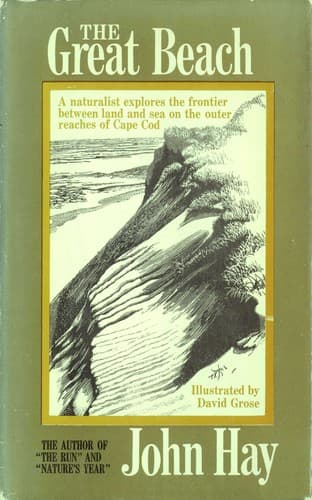
Cape Cod (Mass.) -- Description and travel; Natural history -- Massachusetts -- Cape Cod
All of us are drawn to the sea’s edge as to a fire. Its vast reaches
roll and heave in the light. There is an incalculable weight of waters
withheld just beyond us, a roaming kept in check. What an exalting
thing it is to see those waters dancing with silver castings from the
moon! Even in our careless, civilized state, drinking beer, watching
driftwood burn, or absorbing the sun and one another, in no way
obligated to the kind of cold suffering or exile which sea and seashore
have meant to men in the past, there is something in us that wants this
brilliance, this barren waste.
The sheeted surfaces blown over by all winds rove on with their freight
of light during the day, constantly changing, sometimes black, purple,
and gray under pigeon-silver skies, with hazy, soft horizons, sometimes
silver scudding with gold, or blue, green, and white in all shades; and
always the tidal balance, the surf’s fall and drag at the sand’s edge,
whatever the season.
During the autumn and winter months the cliffs hang their shadows over
the beach very early in the afternoon, cold darkness moving toward an
iridescent surf that reflects the last light of the sun. The sunset
shows curly salmon and fiery orange streaks on the other side of the
vast flat table that often runs with sea ducks at this time of year;
and then, singly, the stars begin to shoot up their spears and arrows,
alignments for eternal navigation.
IV
A Rhythmic Shore
On the beach it might be said that there is no such thing as decline
and decay, although in a physical sense drastic change is obvious,
from year to year and even from minute to minute. In a northern forest
where the trees have been left to grow for many years, I have sensed
the presence of a great establishment, something silent and absolutely
personal, a society of trees with its own strong relationship to the
sun, to the roaring winter winds and snows, to dry years and wet,
using the earth-bound materials of growth, decay, and old age as
provisions for indefinite residence. These tree communities culminate
in “climax” formations, dominated by particular varieties of trees such
as maple and beech, or spruce and fir, to progress no further until
some great interference, such as a lumbering operation, or climatic
change--an increase or decrease in average temperatures over a period
of years--may start a community succession all over again.
Public-domain text, read in full here on John Shaqi.
Reviews
Reviews
No reviews yet
Be the first to share your thoughts on this work.
Join the Discussion
Join the discussion
Sign in to leave a comment or review.
Sign InorCreate an account