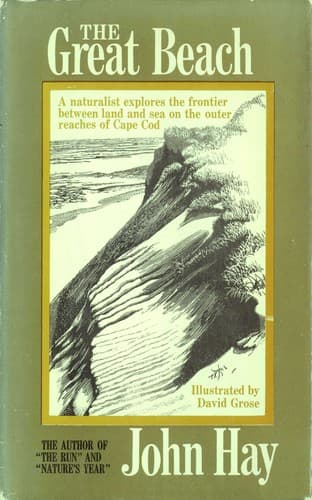
Cape Cod (Mass.) -- Description and travel; Natural history -- Massachusetts -- Cape Cod
Sand is perhaps the apex and symbol of the whole process in which the
existence of the beach is involved. It is moved and shifted grain by
grain in the displacement of its masses, lifted by waves, carried by
currents, and set down again. Sand in the evolution of the beach is not
a static material but an agent of dynamic energy, following out the
motion of water and air, itself their product.
Sand grains, which are of great age, have been worn down from rock
and the mineral grains that make it up, to particles, largely of
quartz, with some feldspar, that are sufficiently durable not to be
reduced to the consistency of mud. The wind which moves the waves and
is the ultimate cause of all beach movement, also may have a more
important effect than water in abrasing and rounding out a sand grain.
The action of grain against grain is more abrasive in the air than
in water, which acts as a cushion. In any case a sand grain made of
quartz reaches a nearly irreducible size after a long period of time.
It might eventually be reduced to powder, but it is now protected by
the grains next to it because of its small size and the film of water
surrounding it. This water, held there by adsorption, is what makes it
possible for tiny animals like nematodes and copepods to exist in such
an environment.
Pick up a handful of moist sand and it is heavy and relatively
cohesive. Through a hand lens you can see the grains fall off in pearly
clumps. On the other hand, dry sand is blown down the beach in its
separate grains like rice, and sorted on different levels according to
its weight and size. Each sparkling grain is an entity unto itself. It
is easily lifted and moved by the energy of waves and currents and at
the same time heavy enough in the mass to give beaches their malleable
stability.
A sand grain is a product of earth, with beauty, quality, and dynamic
character, shining clear in eternal process. Sand has the strength
and resilience needed to hold up against the violent tonnage of the
waves, and at the same time to share in their employment. It is always
being remolded into new shapes by the art of wind and sea, shifting
restlessly, moving from age to age. What we call the inanimate not
only has its weights and measures but also a wonderful proportion with
relation to the forces that send it on. It has a going out that is as
rhythmic in its way and as full of viable light as the migration of
organic lives.
V
Dune Country
Public-domain text, read in full here on John Shaqi.
Reviews
Reviews
No reviews yet
Be the first to share your thoughts on this work.
Join the Discussion
Join the discussion
Sign in to leave a comment or review.
Sign InorCreate an account