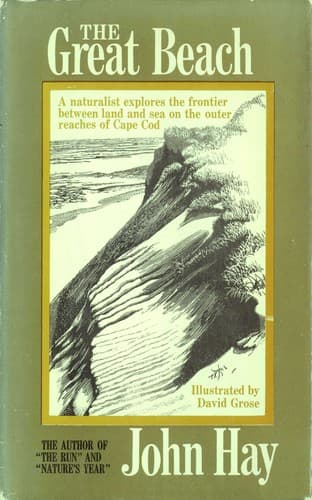
Cape Cod (Mass.) -- Description and travel; Natural history -- Massachusetts -- Cape Cod
The beach grass has had much deserved honor heaped upon it, in the
proportion that it is able to live with the tons of sand that are
also heaped upon it. It is perfectly adapted to being covered over by
sand since it sends up stems which in turn root themselves, and then
grows on, letting the old roots die. As a sand hill builds up, the
beach grass is able to maintain itself in this fashion without being
buried and to hold down the sand with a network of roots and stalks.
It stabilizes such hills until the point where the wind may sweep
so constantly around them as to expose them and cut away the sand,
leaving the grass in splendid isolation with its outer roots hanging in
mid-air. So beach grass and sand have a special collaboration which man
does his best to encourage, especially after he has made rescue work
necessary.
The sand masses have great weight and volume and are stable in
themselves but it is their surfaces that flow and shift with the wind,
so that the whole region is remolded over periods of time. It is
fascinating to sit in a valley between the dunes and reconstruct their
curves, seeing how the sand has been swept down one side and blown up
another, sent over a hill to make a new one on the other side, held for
a long time and then broken loose to change its residence, motion, and
stability joining to make those noble forms.
The dunes may threaten man’s house, or road, or wood lot in immediate
terms, but in themselves they are like distant monuments dedicated
to natural force, perfect, calm, threatening or joining all that
which lies ahead of them with equanimity. Time and its lapses seem
immaterial, more so than the wind that shifts them. Now, or in years
to come, a migrating dune will kill off a tree or a shrub and what
does it matter? Can I care about what happens to one of a thousand
scrub pines? I think not; but perhaps I can care about the event in the
whole sequence of growth, change, and reshaping. Slow and statuesque,
the dunes under the great air are another balance in process, like the
beach beyond them.
I think of some of the trees in the dunes and their struggle with the
winds and the encroaching sands, and I am unable to shed tears over
something that is unable to cry, but sometimes the word desperation
comes to me, when I see evidence of their long efforts to hold on. You
will see a dying cherry tree that has sent shoot after shoot, trunk
after trunk, all over the side of a dune or sand hill that is being
worn away, and they are full of the contortions of struggle--arrested,
like the statue of Laocoön and his sons wrestling with the snakes,
but real enough. Or another hummock or small dune, where a beach plum
or bayberry may not have enough purchase left, has a mass of twisted
branches and twigs strewn down its sides, the wreckage of a genuine
defeat.
Public-domain text, read in full here on John Shaqi.
Reviews
Reviews
No reviews yet
Be the first to share your thoughts on this work.
Join the Discussion
Join the discussion
Sign in to leave a comment or review.
Sign InorCreate an account