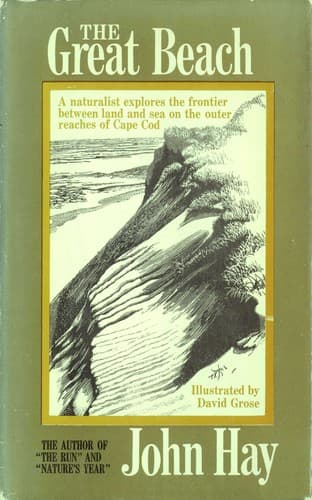
Cape Cod (Mass.) -- Description and travel; Natural history -- Massachusetts -- Cape Cod
Aside from mice, rabbits, skunks, toads, insects, and the indigenous
plants, this seems a place for nomads, and the birds that are free to
forage, like a dark pigeon hawk that swoops across on its hunt for
prey, or an occasional marsh hawk, breast feathers gleaming in the
sunlight, its shadow passing across a dune wall. Little flocks of birds
burst here and there through the thickets, like chickadees, myrtle
warblers, or juncos that move around on the ground pecking for seed. In
their fall migration many of the juncos, or “snowbirds,” reach Cape Cod
by a long, over-the-water route, and flocks that arrive on the Outer
Beach begin to move up into the dunes in a search for fresh water,
perennial pilgrims.
I sat on the top of a high dune one afternoon and watched a beach buggy
swaying and swinging up in my direction along a track that led from the
shore. It droned up and careened by me, plowing and slipping through
the sands, and away down a long slope it went on the dunes’ free forms,
cutting across the shadows that were spearheading toward the sea. Then
I heard children’s voices in the distance coming over quite clear
and shrill, falling off at intervals before the wind. The slopes and
valleys stretched with pure travel in between. It was the kind of place
where all views and associations keep on, across a shifting range. It
lacked fixed ways, decided roads. Only packed in by the open ocean and
the long reaches of time, the roving dunes made a continually majestic
statement which no amount of cans, broken glass, or human footprints
could erase.
Off on the end, the edge, past the cities and the suburbs, the fixed
house lots, the fields, and plains that make a patchwork of an entire
nation, here is a country let go, barren, down to an essential minimum,
but tossing and flowing with its own momentum in an envious proximity
to the sea. It is the first and last land in America.
VI
A Change in History
The history of Cape Cod is fairly well known. I say fairly well because
I do not see how it is possible to recapture the deep complexities of
what was present and now is past, although there is enough past left
in us to provide great confusion about the times we have to face.
Many tourists run after “charm” or what is “quaint,” terms which are
slight enough to admit that they have very little to do with the dark
realities of three centuries. Now we come and go in great bounds, from
great distances. Motion and change make our constancies. We are in no
need of staying put. We are attracted by the starlight in the heavens
we have created for ourselves. We look on the earth’s great flowing
beauties with an inclined eye. For all its “conquest of nature,”
perhaps because of it, our civilization has a tenuous hold on the
waters and lands it occupies. We are in danger of being overlords, not
obligated to what we rule.
Public-domain text, read in full here on John Shaqi.
Reviews
Reviews
No reviews yet
Be the first to share your thoughts on this work.
Join the Discussion
Join the discussion
Sign in to leave a comment or review.
Sign InorCreate an account